
Industrial & machinery
Connections that keep machines running.
Connectors, cable and assemblies for machine building, automation and robotics — chosen for where it actually goes wrong: movement, wear, interference and the shop floor.
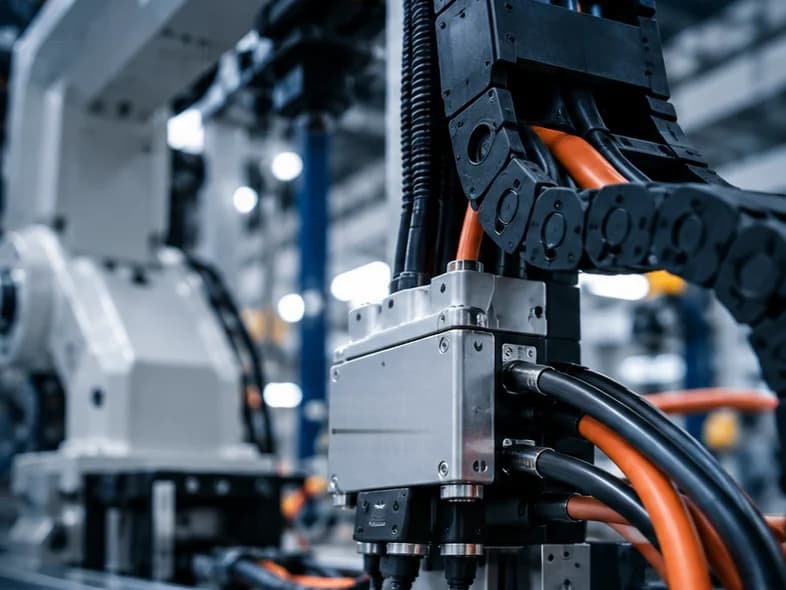
- Uptime
- Movement & drag chains
- Interference
- Moisture & dust
Three environments
Where an hour of downtime costs more than the component.
On the shop floor a connection is moved, shaken, splashed and disturbed — every shift, for years. Where it fails, the line stops.
Machine building
Uptime · Wear · Service life
Where connections sit
- Control cabinets
- Machine wiring
- Sensors & actuators
- Drives & motors
- Operator panels
- Service connections
Automation & robotics
Movement · Flexing · Data
Where connections sit
- Robot cells
- Drag chains
- Industrial Ethernet
- Vision & sensors
- Conveyors & handling
- Industry 4.0 retrofit
Process installations
Moisture · Dust · Interference
Where connections sit
- Washdown areas
- Field instrumentation
- Pumps & valves
- Measurement & control
- Cable entries
- Outdoor installations
Where Belko fits
Eight places on the machine where the connection decides.
From the sensor connector to the cable in the carrier — each one is a starting point in the Belko range.
Application areas
Robots & moving axes
A positive lock and cable support close to the connector.
Junction boxes & enclosures
Enclosures that gather cable and protect the electronics inside.
Industrial Ethernet & sensors
Shielded cable and connectors for Ethernet and sensor data.
Custom cable assemblies
Machine harnesses to your drawing, tested — prototype to series.
Drag chains & moving cable
Thousands of identical movements: the cable’s construction decides its life.
Cable entries & sealing
Glands, grommets and sealed connectors where cable enters a housing.
Power & control cable
Cable chosen for temperature, load, flexing and EMC — jacket included.
Machine connectors
Circular connectors for sensors, actuators and data on the machine.
Industry challenges
Where connections are tested on the shop floor.
These rule out whole product families at once — so they come before the part number.
Unplanned downtime
Downtime is one of the biggest costs in industry — and better connectivity is one of the ways to reduce it.
Movement & flexing
Robotics and drag chains put a cable through the same movement thousands of times: flexibility and mechanical load decide its life.
Vibration
Vibration at the mounting point calls for a positive lock and for cable support close to the connector.
Interference
Drives and motors sit next to signal cable. How the shield is built and terminated decides what reaches the signal.
Moisture, dust & washdown
Washdown areas, dust and condensation call for sealed connections — at the connector and at the termination.
Oils & coolants
Oils and coolants narrow the choice of jacket and seal material to what withstands them.
Cable management
Poor cable management is one of the most overlooked causes of industrial downtime.
Temperature
Near motors, ovens and outdoors, jacket and connector both have to cover the full range of the application.
Working to a specified standard or a machine builder’s own specification? Name it in your enquiry — a specialist checks candidate products against the manufacturer’s documentation.
Technical expertise
Why machine builders choose Belko
- 01
One range for the whole machine
Around 11,800 articles — connectors, cable, accessories, enclosures and tooling — including Telegärtner and FCT, a Molex company.
- 02
Selection from the environment
Start from where the machine stops rather than the part number. A specialist compares the alternatives with you.
- 03
Alternatives when parts are scarce
Belko sources components worldwide. If it isn’t in the catalogue, we go and find it.
- 04
Engineering in the design phase
Engineers think along early, identify bottlenecks and propose improvements — before the machine design is fixed.
- 05
Machine harnesses built in-house
Crimped, soldered, braided, overmoulded and tested on Schleuniger, Komax and GWL equipment — prototype to series.
- 06
Supply that keeps the line running
Purchasing, sourcing and logistics handled from your enquiry on — with just-in-time stock control and vendor managed inventory.
Search & advice
Looking for a connection that keeps the machine running?
Search the technical catalogue by part number, type or property — or tell a specialist where the machine stops: movement, moisture, interference or wear.
Engineering questions
Frequently asked engineering questions
How do I find the right connector for my application?
Start from the environment rather than the part number. Temperature, vibration, sealing, electromagnetic interference and expected service life narrow the field faster than a catalogue search does, because they rule out whole families at once. Work through the three questions on this page to land in the right category, then have a specialist confirm the selection against your drawing or specification before you order.
Start with your applicationCan Belko supply custom cable assemblies?
Yes. Belko assembles single wire, multi-conductor cable, ribbon and coax — crimped by hand and by press, soldered, braided, twisted, overmoulded and electronically tested, from prototype through to series production. If you would rather start than call, the cable assembly configurator collects what you already know in seven short steps and a specialist completes the technical configuration from there.
Start your cable assemblyHow do I know whether I need a waterproof connector?
It depends on what the connection is exposed to rather than on where it sits. Outdoor installations, washdown areas, dust, condensation and splashing all point to a sealed connector, and an IP rating is the shorthand for how much of that a component keeps out. Sealing is decided at the termination as much as by the connector itself, which is why the assembly method matters as much as the rating.
What IP67 and IP68 mean for connectorsCan Belko help with shielding and EMC requirements?
Yes. Shielding is a design question Belko's engineers take part in: foil, braid and combined shields behave differently, and the right choice depends on the frequencies involved, the length of the run and how the shield is terminated. Electrical and mechanical requirements are part of design support, which is where the cable, the connector and the termination are chosen together rather than one at a time.
Foil, braid or both?Can Belko help find an alternative for an existing connector?
Yes. Comparing alternatives is part of product selection at Belko, and components that are not in the catalogue are sourced worldwide. Bring the part number you are replacing and, if you have it, the reason you are replacing it — an end-of-life notice, a delivery problem or a requirement that changed. The reason usually decides which properties of the original actually have to be matched.
Ask a specialistWhat information should I send when I ask for technical advice?
A description of the application is enough to start — you do not need a part number. What speeds it up is the environment the connection sits in, what it has to connect, the quantity you need now and the quantity you might need later, and a drawing, datasheet or photograph if you have one. An attachment usually saves a round trip. Your question reaches a technical specialist, not a form inbox.
Tell us what you're looking forTalk to Belko
Let’s keep your machine running.
Discuss the connection that has to last with a Belko product specialist.