
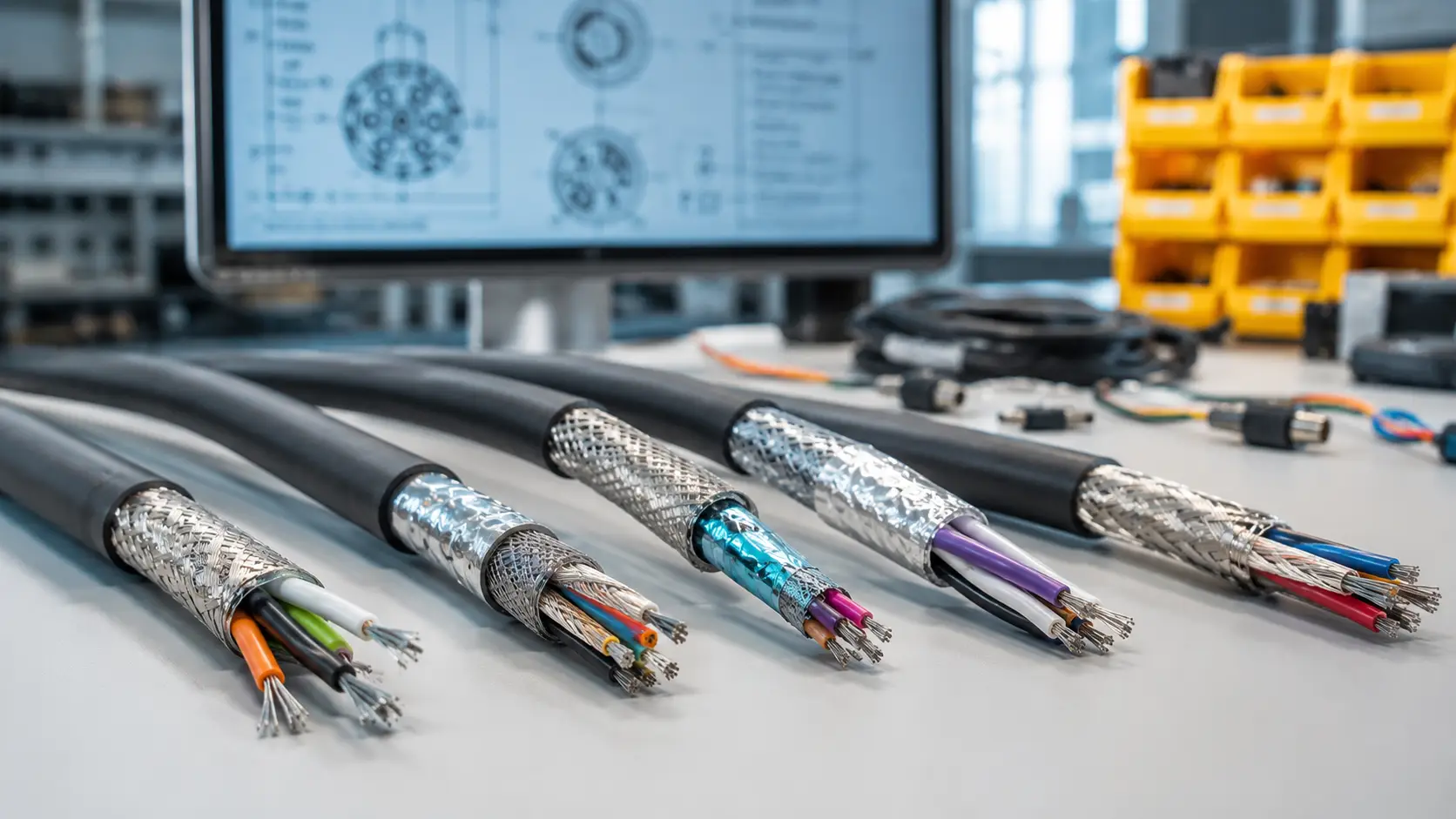
A cable can look perfectly healthy and still be the source of an unreliable machine.
There may be no visible damage, no loose connector and no broken conductor. Yet data packets are lost, sensor values fluctuate or communication fails whenever a motor starts.
In situations like these, electromagnetic interference is often the real problem.
Shielding helps prevent unwanted electrical noise from entering or leaving a cable. However, specifying a “shielded cable” is not always enough. Foil, braid and combined shielding each behave differently, and the quality of the termination can be just as important as the shield itself.
Choosing the right solution starts with understanding what the cable needs to protect against.
What Causes Electromagnetic Interference?
Industrial installations contain many potential sources of electrical noise. Variable-frequency drives, electric motors, switching power supplies, relays, contactors and power cables can all generate electromagnetic fields.
Sensitive signal and communication cables may pick up part of this energy, especially when they run close to power equipment or share the same cable route.
The result is not always a complete system failure. Interference often appears as an intermittent problem:
- unstable sensor readings;
- corrupted data;
- communication errors;
- reduced transmission speed;
- unexpected resets;
- faults that disappear during testing.
These problems are particularly frustrating because the cable may work correctly most of the time.
Shielding creates a conductive barrier around the internal conductors. When it is selected and terminated correctly, that barrier helps control electromagnetic noise before it affects the transmitted signal.
Foil Shielding: Lightweight and Complete Coverage
Foil shielding consists of a thin layer of aluminium, usually bonded to a polyester film and wrapped around the cable conductors.
Its main advantage is coverage. Because the foil forms an almost continuous layer, it can provide effective protection against higher-frequency electromagnetic interference.
Foil also adds relatively little weight and diameter to the cable. This makes it useful in compact equipment, control cabinets and applications where installation space is limited.
A separate drain wire is normally placed in contact with the foil. This wire makes it possible to connect the shield to ground without trying to terminate the delicate foil itself.
Foil shielding is often a good choice for:
- data and communication cables;
- instrumentation;
- sensor connections;
- static installations;
- compact cable constructions;
- environments dominated by higher-frequency noise.
Its limitation is mechanical strength. Repeated bending, twisting or rough handling can damage the thin foil layer. A foil-only construction is therefore not automatically the best option for a continuously moving cable.
Braided Shielding: Strong, Flexible and Durable
A braided shield is made from fine metal strands woven around the internal cable construction.
Unlike foil, a braid does not create completely continuous coverage. Small openings remain between the strands. However, the braid is mechanically stronger and generally maintains its performance better when a cable is bent or moved repeatedly.
It also creates a low-resistance path for unwanted currents and is easier to terminate securely around a connector or cable gland.
Braided shielding is commonly used in:
- industrial machinery;
- motor and drive connections;
- robotics;
- moving equipment;
- applications exposed to vibration;
- cables that require robust connector termination.
The density of the braid matters. A loose braid and a high-coverage braid may both be described as braided shielding, but they will not offer identical performance.
This is one reason why engineers should evaluate the complete cable specification rather than selecting a product based only on the word “shielded”.
Why Some Cables Use Foil and Braid Together
In electrically demanding environments, manufacturers often combine foil and braid.
The foil provides broad, nearly continuous coverage, while the braid adds mechanical durability and a robust path for grounding. Together, they can protect against a wider range of interference than either construction alone.
Combined shielding can be valuable in applications involving:
- high-speed industrial communication;
- RF signals;
- variable-frequency drives;
- medical or measurement equipment;
- long cable runs;
- mixed power and data systems;
- installations with several sources of electrical noise.
The trade-off is that a combined construction is usually thicker, heavier and more expensive. It may also be less flexible than a simpler cable.
More shielding is therefore not automatically better. The correct choice depends on the frequency of the interference, the required movement, the available space and the way the shield will be terminated.
Foil vs Braid at a Glance
| Requirement | Foil | Braid | Foil and braid |
|---|---|---|---|
| Coverage | Very high | Depends on braid density | Very high |
| Mechanical durability | Moderate | High | High |
| Flexibility during repeated movement | Limited | Good | Depends on construction |
| Cable diameter | Small | Larger | Largest |
| Weight | Low | Higher | Highest |
| Connector termination | Usually via drain wire | Strong direct termination | Strong direct termination |
| Typical use | Data and instrumentation | Industrial and moving systems | Demanding EMC environments |
This comparison is a useful starting point, but it should not replace an application-specific assessment.
Shielding Only Works When the Termination Is Correct
A high-quality shield can lose much of its effectiveness when it is terminated poorly.
One common mistake is connecting a braided shield through a long, thin wire. This creates an unshielded transition and adds electrical impedance. At higher frequencies, even a relatively short connection can reduce shielding performance.
Where the application and connector permit it, a 360-degree termination around the connector body generally creates a more continuous shielding path.
Other details also matter:
- the shield should remain intact as close to the connector as possible;
- connector backshells should support the intended shielding method;
- paint, corrosion or contamination should not interrupt the grounding path;
- the shield connection should not carry normal operating current;
- pigtails should be avoided where high-frequency performance is critical.
The cable, shield, connector and enclosure should therefore be treated as one system.
Selecting an excellent cable and then using an unsuitable connector can still result in poor EMC performance.
Should a Cable Shield Be Grounded at One End or Both Ends?
This question has no universal answer.
Connecting a shield at one end can help avoid low-frequency ground-loop currents in certain instrumentation and analogue applications. Connecting it at both ends may provide better high-frequency shielding and is often used in industrial communication or EMC-sensitive equipment.
The correct method depends on:
- signal type;
- operating frequency;
- equipment grounding;
- installation layout;
- applicable standards;
- the manufacturer’s system requirements.
A grounding method should not be selected from habit. It should be defined as part of the electrical and EMC design.
When there is uncertainty, testing the complete installation is considerably more reliable than applying a general rule from another project.
Five Questions to Ask Before Selecting a Shielded Cable
Before choosing a shielding construction, define the application as clearly as possible.
1. What type of signal does the cable carry?
Analogue sensor signals, Ethernet, RF and motor power each create different shielding requirements.
2. What is generating the interference?
A nearby motor drive may require a different approach from radio-frequency equipment or switching electronics.
3. Will the cable move?
A static foil-shielded cable may perform well inside a cabinet but fail prematurely in a drag chain or robotic application.
4. How will the shield connect to the equipment?
The available connector, backshell and enclosure design influence whether the shield can be terminated correctly.
5. How close will the cable run to power wiring?
Routing and separation remain important. Shielding should not be used to compensate for avoidable installation problems.
Answering these questions early prevents an oversized, expensive cable from being selected blindly. More importantly, it reduces the risk of choosing a shield that performs well on paper but poorly in the finished machine.
When a Custom Cable Assembly Makes Sense
Standard shielded cables cover many common applications. They become less practical when a project requires a specific combination of shielding, connectors, jacket material, length and mechanical construction.
A custom cable assembly can combine these requirements in one installation-ready solution.
For example, an assembly may need:
- foil and braided shielding;
- a PUR jacket for continuous movement;
- industrial connectors with metal backshells;
- a defined impedance;
- exact cable and breakout lengths;
- shielding terminated directly to the connector body;
- individual identification and electrical testing.
Designing these elements together is usually more reliable than adapting several standard parts during assembly.
Belko’s Design Support can help evaluate the electrical environment, cable construction and connector interface before production begins. For application-specific lengths, connector combinations or shielding requirements, the Custom Cables service provides a route from technical specification to a finished assembly.
Final Thoughts
Cable shielding is easy to underestimate because most of it remains hidden beneath the outer jacket.
Yet in modern industrial systems, it can determine whether a signal remains stable or becomes vulnerable to every motor, drive and switching device nearby.
Foil provides lightweight, nearly continuous coverage. Braid offers mechanical strength and robust termination. Combining the two can provide broader protection in demanding environments.
The best choice is not necessarily the cable with the most shielding. It is the cable whose electrical performance, mechanical construction and termination method match the actual application.
By considering these factors during the design phase, engineers can prevent difficult troubleshooting, reduce communication errors and build systems that continue to perform reliably after installation.
Need Help Selecting the Right Shielding?
Shielding should be considered together with the conductors, cable jacket, connector and grounding method.
Explore Belko’s Cables and Wires, Connectors and Cable Assemblies, or discuss an application-specific solution through Design Support.
For projects requiring a tailored combination of cable, shielding and connectors, visit Custom Cables or Request a Quote.