
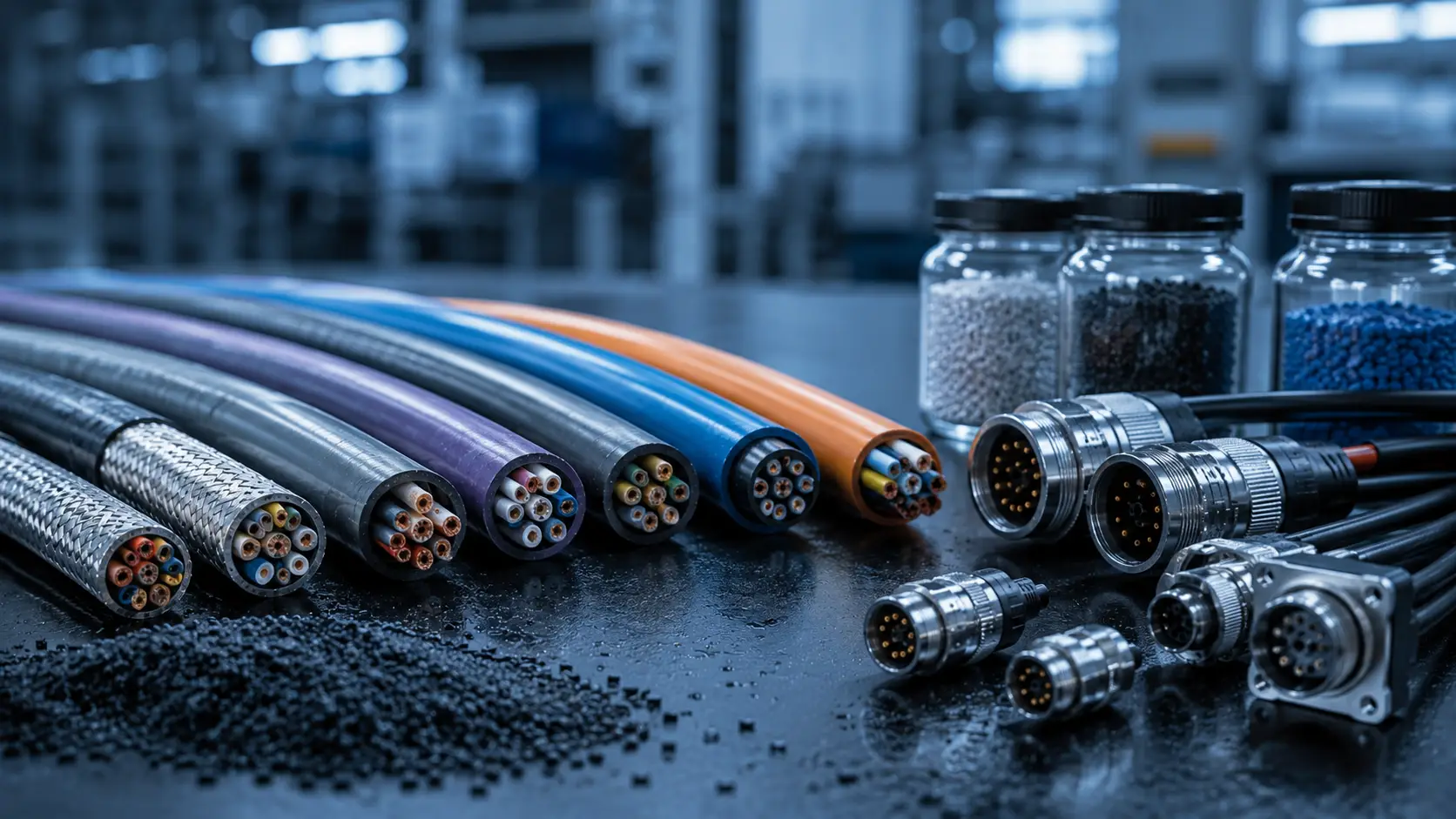
When engineers design a new machine or industrial installation, most attention naturally goes to motors, sensors, controllers, and software.
The cable is often considered much later in the design process.
Even then, discussions usually focus on conductor size, connector type or cable length.
One component rarely receives the attention it deserves: the cable jacket.
That may seem surprising, because the outer jacket is the first line of defence against everything that threatens the cable during its lifetime.
Heat.
Moisture.
Chemicals.
Mechanical wear.
UV exposure.
Continuous movement.
Every one of these factors can significantly reduce cable life if the wrong jacket material is selected.
Unfortunately, this is exactly where many projects go wrong.
Engineers often choose the first material that appears suitable or simply continue using the same specification as previous projects.
While this approach may work in some situations, it can also lead to premature failures, unnecessary maintenance, and avoidable replacement costs.
Selecting the correct cable jacket should therefore never be viewed as a minor technical detail.
It is one of the decisions that has the greatest influence on the long-term reliability of an industrial cable.
What Does a Cable Jacket Actually Do?
Many people assume the cable jacket simply holds the cable together.
In reality, it performs several critical functions simultaneously.
A high-quality jacket protects the internal conductors against external influences while maintaining flexibility, durability and mechanical integrity throughout the cable's service life.
Depending on the application, the outer jacket may need to resist:
- abrasion caused by constant movement
- oils and industrial chemicals
- moisture and water ingress
- ultraviolet radiation
- extreme temperatures
- crushing forces
- repeated bending
- accidental impacts
In some industries, the jacket also needs to comply with fire safety regulations or food-grade requirements.
This means the jacket material often determines whether a cable will continue operating reliably for years—or require replacement after only a short period.
Why There Is No "Best" Cable Jacket
One of the questions we receive most frequently is:
"Which cable jacket material is the best?"
The honest answer is simple.
There isn't one.
Every material has been developed for specific operating conditions.
A material that performs exceptionally well inside a food-processing facility may be completely unsuitable for heavy construction equipment.
Likewise, a jacket designed for outdoor UV exposure may not tolerate aggressive industrial chemicals.
Rather than asking which material is the best, engineers should ask:
Which material is best for my application?
That small change in perspective often leads to a much better design decision.
PVC: The Most Widely Used Cable Jacket Material
Polyvinyl Chloride (PVC) remains one of the most commonly used cable jacket materials worldwide.
Its popularity comes from its versatility, attractive cost, and broad range of applications.
For many standard industrial installations, PVC offers an excellent balance between performance and affordability.
Advantages of PVC
- Cost-effective
- Easy to manufacture
- Good electrical insulation
- Suitable for many indoor applications
- Available in many constructions
PVC is often used in:
- control cabinets
- factory automation
- general industrial equipment
- building installations
- power distribution
Because of its versatility, many engineers automatically specify PVC for new projects.
However, PVC also has limitations that should not be overlooked.
Limitations of PVC
Compared to more advanced materials, PVC is less resistant to:
- continuous flexing
- abrasion
- aggressive chemicals
- prolonged UV exposure
- very low temperatures
For installations exposed to demanding environmental conditions, alternative materials often provide a significantly longer service life.
PUR: Built for Tough Industrial Environments
Where PVC reaches its limits, Polyurethane (PUR) often becomes the preferred solution.
PUR jackets have become increasingly popular in modern automation because they combine excellent mechanical strength with impressive flexibility.
Machines rarely operate under ideal conditions.
Cables are dragged across metal surfaces.
Robotic arms bend them thousands of times per day.
Forklifts may occasionally drive over them.
Oil and grease are common.
In these situations, PUR consistently outperforms many conventional jacket materials.
Why Engineers Choose PUR
PUR offers excellent resistance against:
- abrasion
- tearing
- oils
- lubricants
- mechanical impact
- repeated movement
This makes PUR particularly suitable for:
- robotics
- machine building
- automation systems
- production equipment
- moving cable applications
Another major advantage is its long operational lifespan under mechanical stress.
Although PUR cables typically have a higher initial purchase price than PVC, they often reduce maintenance intervals and replacement frequency.
For many industrial companies, this results in a considerably lower lifecycle cost.
Comparing PVC and PUR
Many projects begin with a discussion between these two materials.
The following overview provides a quick comparison.
| Property | PVC | PUR |
|---|---|---|
| Purchase Cost | ★★★★★ | ★★★☆☆ |
| Flexibility | ★★★☆☆ | ★★★★★ |
| Abrasion Resistance | ★★☆☆☆ | ★★★★★ |
| Oil Resistance | ★★☆☆☆ | ★★★★★ |
| Outdoor Performance | ★★★☆☆ | ★★★★☆ |
| Mechanical Durability | ★★★☆☆ | ★★★★★ |
This comparison illustrates why there is no universal winner.
PVC remains an excellent solution for many applications, while PUR is often the better investment for demanding industrial environments.
Selecting between the two depends entirely on the operating conditions rather than price alone.
Choosing the Right Material Starts Before the Cable Is Designed
One of the biggest mistakes made during cable selection is focusing on the cable construction before analysing the operating environment.
Experienced engineers often work in the opposite direction.
Instead of asking:
"Which cable do we need?"
they first ask:
"What will this cable experience during its lifetime?"
That single question often determines which jacket material will provide the highest reliability.
In the next section, we will examine advanced jacket materials such as TPE, Silicone, PTFE and LSZH, and explain when they outperform both PVC and PUR in specialised industrial applications.
TPE: The Flexible All-Rounder for Dynamic Applications
Thermoplastic Elastomer (TPE) has become increasingly popular in industries where flexibility and durability must go hand in hand.
Unlike PVC, TPE remains highly flexible over a wide temperature range while offering excellent resistance to repeated bending and mechanical stress. This makes it particularly attractive for modern automation systems, robotics, and moving machinery where cables are constantly in motion.
Another important advantage is its resistance to many industrial chemicals, oils, and cleaning agents, allowing it to perform reliably in demanding manufacturing environments.
Typical Applications for TPE
TPE is frequently used in:
- robotic systems
- cable chains
- automated production lines
- industrial sensors
- servo motors
- packaging machinery
Because TPE combines flexibility with mechanical strength, it is often selected when cable movement cannot be avoided.
Although it is generally more expensive than PVC, its longer service life often compensates for the higher initial investment.
Silicone: When Temperature Becomes the Biggest Challenge
Not every industrial environment is mechanically demanding.
Some applications are defined primarily by temperature.
In these situations, silicone cable jackets offer significant advantages.
Silicone remains flexible even at extremely low temperatures while maintaining excellent performance at very high temperatures. This unique combination makes it one of the preferred materials for environments where thermal stability is essential.
Examples include:
- industrial ovens
- heating equipment
- laboratory systems
- medical equipment
- food processing machinery
- climate chambers
Unlike many traditional materials, silicone does not become brittle after prolonged exposure to heat.
However, engineers should also be aware of its limitations.
Silicone offers less resistance to abrasion than PUR, meaning it is generally less suitable for environments where cables experience constant mechanical wear.
As always, selecting the right material depends on understanding the operating conditions rather than focusing on one specific performance characteristic.
PTFE: Built for the Most Demanding Conditions
Some industrial applications push cable materials to their absolute limits.
Extreme temperatures.
Aggressive chemicals.
Corrosive environments.
Highly sensitive electronics.
For these situations, Polytetrafluoroethylene (PTFE) is often considered one of the highest-performing cable jacket materials available.
Most people know PTFE under the brand name Teflon®, but within industrial connectivity it represents far more than a non-stick coating.
PTFE offers exceptional resistance against:
- chemicals
- solvents
- acids
- fuels
- UV radiation
- moisture
- extreme temperatures
Because of these properties, PTFE is frequently used in:
- aerospace systems
- defence applications
- laboratory equipment
- semiconductor manufacturing
- medical technology
- high-frequency communication systems
Its outstanding electrical properties also make PTFE particularly suitable for specialised RF cable assemblies, where maintaining signal integrity is critical.
Although PTFE is one of the more expensive jacket materials, its performance under extreme conditions often justifies the investment.
LSZH: Protecting People as Well as Equipment
When discussing cable performance, engineers naturally focus on durability and reliability.
However, in many public buildings and transportation systems, safety becomes equally important.
This is where Low Smoke Zero Halogen (LSZH) cable jackets play a crucial role.
Unlike conventional PVC, LSZH materials are specifically designed to produce:
- significantly less smoke
- no halogen gases
- reduced toxic emissions during fire
This improves visibility during evacuation while reducing the risk of corrosive damage to surrounding equipment.
For this reason, LSZH cables are commonly specified in:
- railway infrastructure
- airports
- hospitals
- tunnels
- office buildings
- data centres
- public transport
While LSZH offers excellent fire performance, it may not always provide the same mechanical durability as materials such as PUR.
Selecting LSZH therefore requires balancing fire safety requirements against environmental and mechanical conditions.
Comparing the Most Common Cable Jacket Materials
Every material has strengths and weaknesses.
The table below provides a practical overview for engineers comparing the most common options.
| Property | PVC | PUR | TPE | Silicone | PTFE | LSZH |
|---|---|---|---|---|---|---|
| Cost | ★★★★★ | ★★★☆☆ | ★★★☆☆ | ★★☆☆☆ | ★☆☆☆☆ | ★★★☆☆ |
| Flexibility | ★★★☆☆ | ★★★★★ | ★★★★★ | ★★★★★ | ★★★★☆ | ★★★☆☆ |
| Abrasion Resistance | ★★☆☆☆ | ★★★★★ | ★★★★☆ | ★★☆☆☆ | ★★★★☆ | ★★★☆☆ |
| Chemical Resistance | ★★★☆☆ | ★★★★★ | ★★★★☆ | ★★★☆☆ | ★★★★★ | ★★★☆☆ |
| High Temperature | ★★☆☆☆ | ★★★☆☆ | ★★★☆☆ | ★★★★★ | ★★★★★ | ★★★☆☆ |
| UV Resistance | ★★★☆☆ | ★★★★☆ | ★★★★☆ | ★★★★☆ | ★★★★★ | ★★★☆☆ |
| Typical Industrial Use | General | Heavy Industry | Automation | High Heat | Extreme Conditions | Public Buildings |
As this comparison shows, there is no universally superior material.
Each one has been developed to solve a different engineering challenge.
Real-World Example 1: A Packaging Machine
A manufacturer of automated packaging equipment originally specified PVC cables throughout the machine.
After approximately eighteen months, maintenance teams noticed increasing cable failures near moving axes.
Following an engineering review, the standard cables were replaced with a custom-designed solution using PUR jackets.
The result was immediate:
- fewer cable replacements
- reduced maintenance interventions
- improved machine availability
- lower lifetime operating costs
Nothing else in the machine changed.
Only the cable jacket material.
Real-World Example 2: Food Processing Equipment
A food processing company needed cables capable of withstanding frequent high-pressure cleaning while maintaining flexibility.
Initially, the engineering team focused only on connector selection.
After further analysis, they realised the jacket material would have an even greater impact on long-term reliability.
By combining suitable waterproof connectors with an application-specific jacket material developed through custom cable solutions, the company significantly improved equipment reliability while reducing maintenance downtime.
The project demonstrated an important engineering principle:
A connector and a cable should never be selected independently.
They should always be considered as one integrated interconnect solution.
Material Selection Should Never Be Based on Price Alone
During procurement, purchase price often receives the most attention.
While understandable, this approach can become expensive over the lifetime of an installation.
Replacing a failed cable inside an operating production line is rarely limited to the cost of the cable itself.
Additional expenses often include:
- production downtime
- technician labour
- machine access
- troubleshooting
- replacement components
- production delays
In many cases, the difference between selecting the right material and the wrong one is measured not in euros per metre, but in thousands of euros over the operational life of the equipment.
For this reason, experienced engineers evaluate cable jacket materials based on total lifecycle performance rather than initial purchase price alone.
The outer jacket may appear to be one of the simplest parts of a cable, but in demanding industrial environments it often becomes one of the most influential factors in long-term reliability.
Which Cable Jacket Material Is Best for Your Industry?
One of the biggest misconceptions in cable design is that a single jacket material can perform well in every environment. In reality, every industry presents its own challenges, and the best-performing cable in one application may perform poorly in another.
The key is to match the jacket material to the operating environment rather than selecting the material first.
Below are some of the most common industrial applications and the cable jacket materials that are typically best suited for them.
Manufacturing and Factory Automation
Production facilities expose cables to continuous movement, vibration, accidental impacts, lubricants, and occasional contact with chemicals.
Reliability is essential because every unexpected cable failure can interrupt production.
For these environments, PUR is often the preferred choice due to its excellent abrasion resistance and long service life.
Applications include:
-
Assembly lines
-
CNC machines
-
Automated production systems
-
Packaging equipment
-
Industrial robots
For systems with continuous movement, combining a durable jacket with high-quality custom cable solutions significantly improves long-term reliability.
Robotics and Motion Control
Robotic applications create one of the most demanding environments for industrial cables.
Unlike static installations, robotic cables may bend thousands—or even millions—of times during their lifetime.
Repeated movement places enormous stress on the outer jacket.
Materials with poor flexibility often develop cracks, causing moisture ingress and conductor damage.
For dynamic applications, engineers frequently choose:
-
PUR
-
TPE
These materials offer excellent flexibility while maintaining high resistance to abrasion.
The exact construction depends on factors such as bend radius, torsional movement and cable chain requirements.
Outdoor Installations
Outdoor environments introduce additional challenges that are often overlooked during the design phase.
Besides rain and moisture, cables must also resist:
-
UV radiation
-
Temperature fluctuations
-
Dirt
-
Mechanical wear
-
Wind-induced movement
For outdoor applications, engineers often select PUR or PTFE depending on the environmental conditions.
When moisture protection is critical, combining the appropriate jacket with waterproof connectors creates a significantly more reliable interconnect solution.
Food and Beverage Processing
Food production facilities place unique demands on industrial cables.
Equipment is frequently cleaned using:
-
high-pressure water
-
steam
-
aggressive cleaning agents
-
disinfectants
At the same time, hygiene standards require materials that can withstand regular washdowns without degrading.
Depending on the application, silicone, TPE or specially engineered PUR constructions are commonly selected.
Material selection should always consider both the cleaning process and the mechanical conditions during production.
Medical Equipment
Medical devices require a different balance of properties.
Rather than extreme abrasion resistance, engineers often prioritise:
-
flexibility
-
cleanliness
-
reliability
-
compact cable design
-
consistent electrical performance
Applications such as imaging equipment, patient monitoring systems and laboratory devices often benefit from carefully engineered custom cable assemblies designed specifically for medical environments.
Railway and Public Infrastructure
In public environments, passenger safety becomes one of the highest priorities.
This is why LSZH materials are widely used.
In the event of fire, reduced smoke and the absence of halogen gases improve evacuation safety while minimising damage to surrounding electronic equipment.
Typical applications include:
-
railway vehicles
-
metro systems
-
tunnels
-
airports
-
public buildings
Aerospace and Defence
Few industries demand higher performance than aerospace and defence.
Extreme temperatures, vibration, strict weight limitations and demanding electrical requirements all influence material selection.
PTFE is frequently specified because it offers exceptional chemical resistance, excellent thermal stability and outstanding electrical properties.
In these industries, selecting the correct cable construction is rarely left to standard catalogue products.
Instead, application-specific design support and custom cable solutions are often required from the earliest design stages.
Cable Jacket Selection Matrix
The table below provides a practical starting point when comparing cable jacket materials.
| Application | Recommended Material | Main Reason |
|---|---|---|
| General industrial equipment | PVC | Cost-effective and versatile |
| Heavy industrial machinery | PUR | Abrasion and oil resistance |
| Robotics | PUR / TPE | Continuous movement |
| Cable chains | TPE | High flexibility |
| Outdoor installations | PUR / PTFE | UV and weather resistance |
| Food processing | TPE / Silicone | Cleaning resistance |
| Medical equipment | Silicone | Flexibility and temperature stability |
| Aerospace | PTFE | Extreme environments |
| Railway & public buildings | LSZH | Fire safety |
This matrix should be viewed as a guideline rather than a fixed rule.
Every project has unique requirements, and factors such as connector selection, shielding, conductor size and installation conditions should always be evaluated alongside the jacket material.
10 Common Mistakes When Selecting a Cable Jacket Material
Even experienced engineers occasionally underestimate the importance of the outer jacket.
The following mistakes appear regularly across industrial projects.
1. Choosing Based Only on Price
The least expensive material often becomes the most expensive over the lifetime of the installation.
2. Ignoring Mechanical Movement
Repeated bending dramatically reduces the lifespan of materials that are not designed for dynamic applications.
3. Forgetting About Chemicals
Industrial oils, cleaning agents and solvents can quickly degrade unsuitable materials.
4. Underestimating UV Exposure
A cable that performs perfectly indoors may deteriorate rapidly when installed outdoors.
5. Overlooking Temperature Extremes
Both excessive heat and freezing temperatures influence cable flexibility and durability.
6. Selecting Connectors Independently
The connector and cable should always be engineered together.
A premium connector cannot compensate for an unsuitable cable jacket.
7. Ignoring Future Expansion
Designing for today's requirements alone often results in expensive modifications later.
8. Assuming Every PUR or PVC Cable Is the Same
Material quality varies considerably between manufacturers.
Always evaluate the complete cable specification rather than the material name alone.
9. Forgetting Maintenance Accessibility
A well-designed cable should not only perform well—it should also be easy to inspect and replace if necessary.
10. Waiting Until the Final Design Phase
Cable selection is often postponed until the end of a project.
In reality, cable design should be considered much earlier, as it influences routing, connectors, installation space and overall system reliability.
Engineering Tips for Selecting the Right Cable Jacket
If you're designing a new industrial system, these practical recommendations can help simplify material selection.
✓ Start with the operating environment—not the cable catalogue.
✓ Consider the complete lifecycle rather than the purchase price.
✓ Evaluate movement, vibration and mechanical stress.
✓ Think about future maintenance before installation begins.
✓ Select connectors and cable jackets as one integrated solution.
✓ Don't underestimate UV exposure or cleaning chemicals.
✓ Involve experienced cable specialists early in the design process.
These simple steps often prevent costly redesigns and significantly improve long-term system reliability.
Featured Snippet: How Do You Choose the Right Cable Jacket Material?
The correct cable jacket material depends on the operating environment, mechanical stress, temperature range, chemical exposure, flexibility requirements and applicable industry standards.
-
PVC is suitable for general industrial applications.
-
PUR performs best in demanding mechanical environments.
-
TPE is ideal for flexible and continuously moving applications.
-
Silicone excels in extreme temperature conditions.
-
PTFE is designed for harsh chemical and high-performance environments.
-
LSZH is preferred where fire safety and low smoke emissions are critical.
Choosing the right material early in the design process helps improve reliability, reduce maintenance and extend the service life of the complete cable assembly.
How Belko Helps Engineers Choose the Right Cable Jacket Material
Selecting the right cable jacket material is rarely a matter of comparing two data sheets.
In many projects, the answer depends on a combination of environmental conditions, electrical requirements, mechanical stress, installation constraints and future maintenance considerations.
A cable that performs exceptionally well in one application may not be the right choice in another.
This is why many engineers involve cable specialists early in the design process.
At Belko, every project starts with understanding the application rather than recommending a product.
Questions such as:
-
Will the cable be exposed to continuous movement?
-
Is there a risk of oil, chemicals or moisture?
-
Will the installation operate outdoors?
-
Are there strict fire safety requirements?
-
Does the application require RF, fibre optic or industrial Ethernet connectivity?
-
Is future scalability important?
help determine the most suitable combination of cable construction, jacket material and connector technology.
Rather than adapting your design to fit a standard product, Belko focuses on developing custom cable solutions that match the exact technical requirements of your application.
This approach often results in:
-
improved reliability
-
simplified installation
-
longer service life
-
lower maintenance costs
-
reduced downtime
-
easier future upgrades
Because every industrial environment is different, there is rarely a universal solution.
Engineering expertise remains one of the most valuable components of every successful cable project.
When Is a Standard Cable Enough?
Not every application requires a fully customised cable.
For many static indoor installations operating under controlled conditions, a standard cable may provide an excellent balance between cost and performance.
Standard products are often suitable when:
-
environmental conditions remain stable
-
cable routing is straightforward
-
mechanical stress is minimal
-
connector options are standardised
-
installation space is not restricted
In these situations, selecting an existing cable can reduce lead time and simplify procurement.
However, industrial applications rarely remain unchanged throughout their lifetime.
As systems evolve, additional requirements often emerge.
Machines become faster.
Production environments become more demanding.
New sensors are added.
Communication protocols change.
Installation space becomes increasingly limited.
At this point, standard cables may no longer offer the flexibility or reliability required.
When Does a Custom Cable Become the Better Choice?
A custom-designed cable becomes increasingly valuable whenever the application introduces challenges that standard products cannot easily solve.
Typical examples include:
-
unique connector combinations
-
non-standard cable lengths
-
limited installation space
-
repeated movement or torsion
-
harsh environmental conditions
-
multiple signal types within one cable assembly
-
specialised shielding requirements
-
demanding mechanical performance
Instead of compromising with adapters, extensions or unnecessary cable length, a tailored solution can be designed specifically around the application.
This often simplifies installation while improving long-term reliability.
For engineers developing complex industrial systems, investing in Custom Cables frequently results in lower lifecycle costs than modifying standard products.
Simplify Engineering with Belko's Online Cable Configurators
Engineering time is valuable.
Rather than spending hours searching through catalogues or manually specifying every cable characteristic, Belko provides online configuration tools that simplify the design process.
Depending on the application, engineers can quickly define technical requirements before requesting a quotation.
RF Cable Configurator
For RF applications where signal integrity is essential, the RF Cable Configurator allows engineers to configure cable assemblies based on their specific performance requirements.
Instead of starting from scratch, users can define key parameters that help accelerate both engineering and quotation processes.
Fiber Optic & RJ45 Patch Cable Configurator
For fibre optic communication and industrial Ethernet networks, the Fiber Optic & RJ45 Patch Cable Configurator provides an efficient way to specify cable assemblies tailored to the application.
This reduces specification errors while ensuring that critical design requirements are captured early in the project.
Need Something More Complex?
Not every application fits inside a configurator.
Projects involving hybrid cable assemblies, specialised shielding, unique connector combinations or demanding environmental conditions often require a more collaborative engineering approach.
In these situations, Belko's experienced engineering team can provide Design Support throughout the development process, helping transform application requirements into reliable, production-ready interconnect solutions.
Final Thoughts
The outer jacket may appear to be one of the simplest parts of a cable, yet it has a greater influence on long-term performance than many engineers initially realise.
Choosing the correct cable jacket material is not simply about selecting PVC, PUR or another material from a specification sheet.
It is about understanding the complete operating environment.
Mechanical movement.
Chemical exposure.
Temperature.
UV radiation.
Cleaning procedures.
Installation constraints.
Maintenance requirements.
Every one of these factors contributes to the overall reliability of the finished cable assembly.
The most successful industrial projects rarely result from selecting the "strongest" material.
Instead, they come from selecting the material that best matches the application.
Whether that turns out to be PVC, PUR, TPE, Silicone, PTFE or LSZH depends entirely on the engineering challenge in front of you.
Taking the time to evaluate these requirements before production begins helps reduce maintenance, improve system uptime and extend the operational life of both the cable and the equipment it supports.
Ultimately, selecting the right cable jacket is not just about protecting a cable.
It is about protecting the performance, reliability and future success of the complete system.
Ready to Design the Right Cable for Your Application?
Every project is different.
If you're unsure which cable jacket material best suits your application, Belko's engineering specialists are ready to help.
Whether you require a fully customised cable assembly, expert advice during the design phase or a fast way to configure your next cable, we offer solutions tailored to your project.
Explore our:
-
Custom Cables solutions for fully engineered cable assemblies.
-
RF Cable Configurator for high-performance RF cable assemblies.
-
Fiber Optic & RJ45 Patch Cable Configurator for fibre optic and Ethernet applications.
-
Design Support services for technical guidance throughout your project.
Need personalised advice?
Visit our Contact page or request a Quote. Our engineers are happy to help you find the right solution.
Frequently Asked Questions
Which cable jacket material lasts the longest?
There is no single material that lasts the longest in every situation. The lifespan depends on the operating environment. PUR performs exceptionally well in abrasive industrial environments, while PTFE excels in extreme chemical and temperature conditions.
Is PUR always better than PVC?
Not necessarily. PUR offers superior abrasion resistance, flexibility and oil resistance, but PVC remains an excellent and cost-effective solution for many standard industrial applications.
Which cable jacket is best for outdoor use?
Outdoor applications typically benefit from PUR or PTFE because of their excellent resistance to UV radiation, moisture and changing weather conditions.
What is the difference between cable insulation and the cable jacket?
Cable insulation surrounds the individual conductors and prevents electrical contact between them. The cable jacket is the outer protective layer that shields the complete cable against environmental and mechanical influences.
Which cable jacket material is best for robotics?
Applications involving continuous movement usually benefit from highly flexible materials such as PUR or TPE, depending on the required bending radius and mechanical load.
Why are LSZH cables used in public buildings?
LSZH materials produce very little smoke and no corrosive halogen gases during a fire, improving evacuation safety and reducing damage to nearby electronic equipment.
Can Belko help design custom cable solutions?
Yes. Belko provides Design Support, develops fully Custom Cable solutions and offers dedicated online configurators for RF cables and Fibre Optic & RJ45 Patch Cables.
When should I use an online cable configurator?
Online configurators are ideal when you already know the basic technical requirements and want to configure an RF cable assembly or Fibre Optic & RJ45 Patch Cable quickly and efficiently before requesting a quotation.