
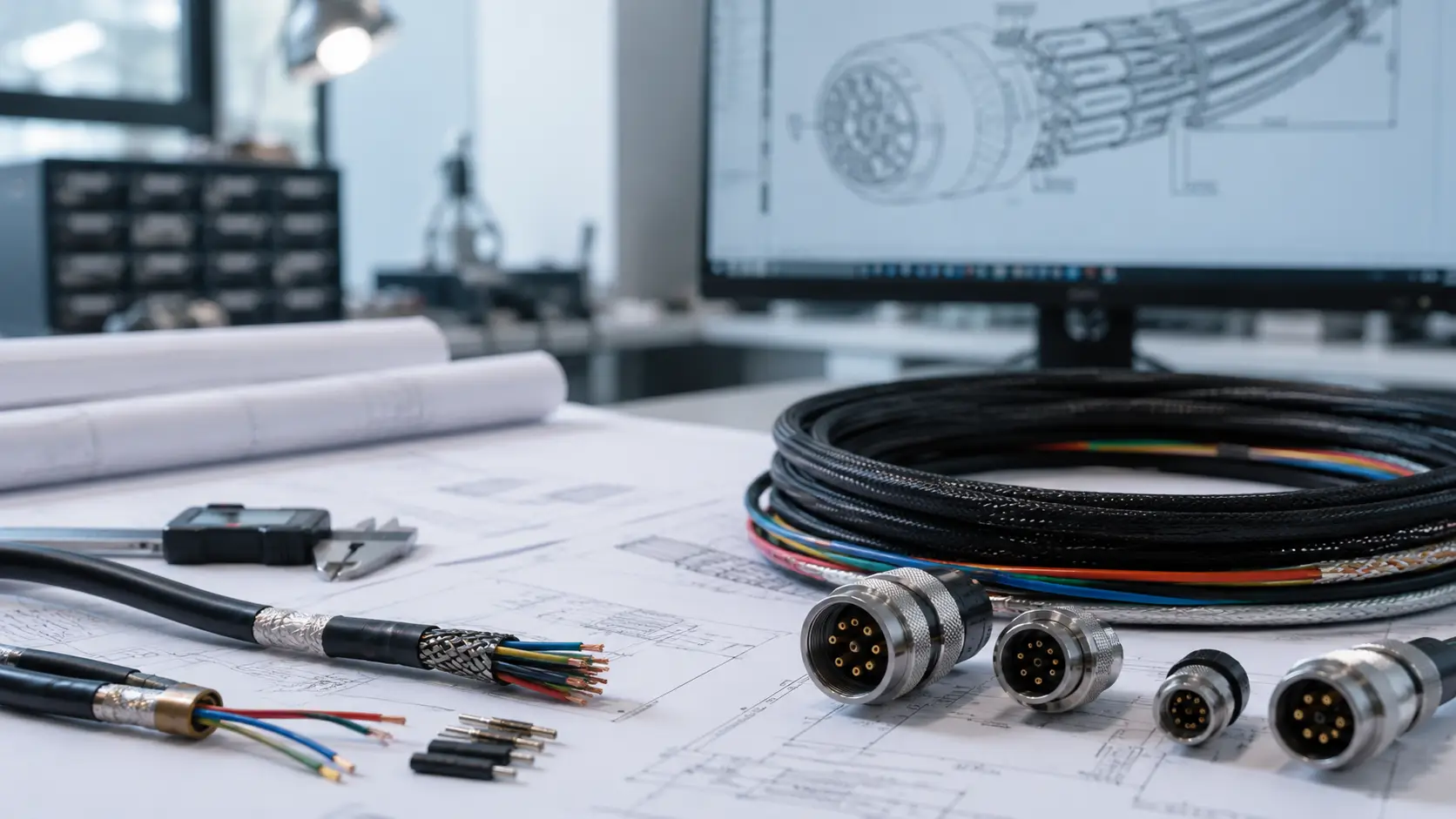
A custom cable is rarely "just a cable."
For engineers and product designers, it is often one of the last components specified during a project. Ironically, it is also one of the components that can determine whether an installation performs reliably for years—or becomes a recurring source of failures, maintenance calls, and costly downtime.
Many projects begin with a simple request:
"We just need a cable between these two devices."
A few weeks later, additional requirements start appearing.
The cable must survive vibration.
It needs to fit inside a limited installation space.
It must withstand outdoor conditions.
The connector orientation is wrong.
The shielding is insufficient.
Suddenly, what looked like a simple component has become a critical engineering challenge.
Fortunately, most of these problems can be avoided by asking the right questions before the design phase begins.
In this article, we explain the ten most important considerations every engineer should evaluate before ordering a custom cable.
Why Custom Cable Design Matters More Than Ever
Industrial equipment is becoming smarter, more compact, and more connected.
Automation systems exchange increasing amounts of data.
Machines operate faster.
Installation spaces continue to shrink.
Environmental conditions become more demanding.
As systems become more sophisticated, standard off-the-shelf cables often become the limiting factor rather than the solution.
A properly engineered custom cable is designed around the application instead of forcing the application to adapt to a standard product.
This approach improves reliability, simplifies installation, and often reduces the total cost of ownership throughout the system's lifecycle.
Before selecting materials, connectors, or cable lengths, experienced engineers start by asking the right questions. The answers below form the foundation of a reliable custom cable design and can help prevent costly redesigns later in the project.
Question 1: What Is the Cable Actually Required to Do?
This sounds obvious, but many cable projects start without clearly defining the cable's function.
Ask yourself:
- Is the cable transmitting power?
- Is it carrying high-speed data?
- Is it transporting RF signals?
- Does it combine multiple signal types?
- Will it supply power and communication simultaneously?
Each application places different demands on the cable construction.
For example, an RF application requires entirely different shielding and impedance characteristics than an Ethernet connection or a power cable.
Defining the function first prevents expensive redesigns later.
Question 2: In What Environment Will the Cable Operate?
Environmental conditions have a greater impact on cable performance than many people expect.
A cable performing perfectly inside a climate-controlled cabinet may fail quickly when exposed to:
- moisture
- UV radiation
- chemicals
- vibration
- dust
- continuous movement
- extreme temperatures
Instead of selecting a cable first, start by understanding the environment.
This often determines the required insulation materials, connector sealing, protective jackets, and mechanical construction.
Applications exposed to demanding environments frequently benefit from waterproof connectors, durable accessories, and protective grommets & sealing rings.
Question 3: How Much Space Is Actually Available?
Cable routing is one of the most underestimated aspects of cable design.
Engineers often focus on electrical specifications while overlooking the physical installation.
Questions worth asking include:
- Is there enough bending radius?
- Will the cable pass through moving parts?
- Is installation space limited?
- Are there sharp corners?
- Will maintenance technicians have easy access?
A cable that technically works but cannot be installed efficiently is rarely the right solution.
Custom cable design allows dimensions, breakout lengths, and connector orientations to be optimized for the available space.
Question 4: Are Standard Connectors Really the Best Choice?
Selecting a connector is about far more than matching two interfaces.
The connector should also be evaluated for:
- durability
- mating cycles
- locking mechanisms
- environmental sealing
- vibration resistance
- future maintenance
Choosing the wrong connector often creates reliability problems long after installation.
This is why many engineers choose high-quality connectors specifically designed for industrial environments instead of general-purpose alternatives.
Question 5: Will the Design Need to Change in the Future?
One of the biggest mistakes in product development is designing only for today's requirements.
Consider questions such as:
- Could additional sensors be added?
- Might communication protocols change?
- Will future revisions require more bandwidth?
- Is expansion already planned?
Building flexibility into the cable today often prevents costly redesigns tomorrow.
Scalable custom cable solutions make future upgrades significantly easier.
Engineering Checklist
Before requesting a quotation, verify the following:
| Design Consideration | Status |
|---|---|
| Electrical requirements defined | □ |
| Environmental conditions identified | □ |
| Connector type selected | □ |
| Cable routing evaluated | □ |
| Mechanical stress assessed | □ |
| Future scalability considered | □ |
| Shielding requirements determined | □ |
| Compliance requirements checked | □ |
Completing this checklist before starting production dramatically increases the chances of a successful project.
Not Every Custom Cable Is the Same
The term "custom cable" covers an enormous range of applications.
Some projects involve relatively straightforward power cables.
Others require highly specialized RF assemblies, fiber optic connections, or hybrid cable systems.
For this reason, selecting the right design process is often just as important as selecting the right components.
Instead of choosing from hundreds of standard part numbers, modern engineering increasingly focuses on configuring cables around the application's exact requirements.
That is where digital engineering tools are becoming increasingly valuable.
In the next section, we'll look at how online cable configurators can dramatically reduce engineering time, improve design accuracy, and simplify the process of specifying RF cables, fiber optic cables, and industrial Ethernet connections.
Question 6: How Important Is Signal Integrity?
As data speeds continue to increase, signal integrity has become one of the most important aspects of cable design. A cable that performs well at lower frequencies may struggle when transmitting high-speed digital signals or radio frequency (RF) data.
Poor signal integrity can lead to:
- Data corruption
- Reduced communication speeds
- Electromagnetic interference (EMI)
- Increased error rates
- Unstable system performance
For applications involving RF communication, industrial Ethernet, or fibre optic networks, cable performance depends on much more than conductor quality. Factors such as shielding, impedance, connector quality and assembly precision all play an important role.
Investing time in the design phase helps prevent problems that are often difficult and expensive to diagnose once a system is operational.
Question 7: Can the Cable Be Installed and Maintained Easily?
A well-designed cable should not only perform well—it should also be practical to install and maintain.
During the design process, consider questions such as:
- Can technicians easily access the connectors?
- Is there enough space to disconnect and reconnect the cable?
- Will the cable need to be replaced regularly?
- Can maintenance be performed without dismantling large parts of the machine?
Designing with maintenance in mind reduces service time and lowers operational costs throughout the lifetime of the equipment.
Question 8: Which Standards Must Be Met?
Different industries have different compliance requirements.
Depending on the application, your cable may need to comply with standards relating to:
| Requirement | Typical Applications |
|---|---|
| EMC compatibility | Industrial automation |
| Fire resistance | Rail & infrastructure |
| UV resistance | Outdoor installations |
| Chemical resistance | Manufacturing & processing |
| Food-grade materials | Food production |
| Medical compliance | Healthcare equipment |
Considering these requirements early in the design phase helps prevent delays later in the project.
Question 9: Should You Configure or Design From Scratch?
One of the biggest improvements in engineering over the past few years has been the introduction of online cable configurators.
Instead of starting with a blank sheet of paper, engineers can configure a solution based on predefined technical options.
This approach offers several advantages:
✓ Faster engineering process
✓ Fewer specification errors
✓ Better technical consistency
✓ Easier quotation process
✓ Faster communication between customer and supplier
For many projects, using an online configurator significantly reduces the time between concept and production.
Belko provides dedicated configuration tools for both RF cable assemblies and fibre optic & RJ45 patch cables, allowing engineers to define many technical parameters before requesting a quotation.
Question 10: Who Will Support You After Delivery?
A cable is rarely an isolated product.
It becomes part of a much larger system.
That means long-term technical support can be just as valuable as the product itself.
When selecting a supplier, consider questions like:
- Can they assist during the design phase?
- Do they understand industrial applications?
- Can they help optimise future revisions?
- Is engineering support available when requirements change?
Long-term partnerships often deliver greater value than one-off purchases.
This is why many OEMs and industrial manufacturers look beyond pricing alone and choose suppliers who combine product knowledge with engineering expertise.
Standard Cable vs Custom Cable: Which Is Right for You?
Although standard products have their place, they are not always the most efficient solution.
| Standard Cable | Custom Cable |
| Fixed specifications | Designed around your application |
| Limited connector options | Wide range of connector combinations |
| May require adapters | Direct fit for your equipment |
| Often excess cable length | Optimised cable length |
| General-purpose | Application-specific solution |
The more complex your installation becomes, the greater the benefits of a custom-designed solution.
Practical Example
Imagine a machine builder developing a new automated packaging system.
Initially, the engineering team specifies several standard cables because they are readily available.
During installation, they discover:
- One cable is too short.
- Another is excessively long.
- Two connectors interfere with neighbouring components.
- Additional adapters are required.
- Installation takes longer than expected.
These issues increase costs and delay commissioning.
Now consider the same project using a tailored cable solution.
The cable lengths match the installation perfectly, the connectors are correctly orientated, and the assemblies arrive ready for installation.
The result is a cleaner build, a faster installation process and fewer unexpected problems during commissioning.
Why More Engineers Are Using Online Cable Configurators
Engineering projects are becoming increasingly complex, while development schedules continue to shrink.
Online configurators help bridge this gap by allowing engineers to define technical requirements before production begins.
Instead of exchanging multiple emails or manually specifying every detail, many parameters can be selected directly.
This creates a more efficient workflow for both engineers and manufacturers.
If your project involves RF cable assemblies, Belko's RF Cable Configurator provides an efficient starting point for defining your requirements.
For fibre optic and industrial Ethernet applications, the Fiber Optic & RJ45 Patch Cable Configurator simplifies the specification process while reducing the risk of configuration errors.
For more complex projects involving multiple cable types or application-specific requirements, Belko's Custom Cables team can assist in developing a complete tailored solution.
Final Thoughts
Successful cable design is rarely about choosing the most expensive components.
It is about asking the right questions before production starts.
Understanding the application, the environment, future expansion plans and installation requirements allows engineers to make better decisions that improve reliability, simplify installation and reduce long-term costs.
Whether you are designing a single prototype or preparing for large-scale production, investing time in the design phase almost always pays dividends later.
The right cable does far more than connect two devices—it supports the performance, reliability and future scalability of the entire system.
Ready to Design Your Next Custom Cable?
Whether you're designing an RF cable assembly, specifying a fibre optic connection or developing a completely new industrial cable solution, Belko offers the tools and expertise to help you move from concept to production.
Explore our Custom Cables solutions, start configuring your next assembly with the RF Cable Configurator or use the Fiber Optic & RJ45 Patch Cable Configurator to quickly define your requirements.
If you need technical guidance, our specialists are happy to help. Visit our Design Support page, contact our team via the Contact page or request a Quote for your project.
Frequently Asked Questions
When should I choose a custom cable instead of a standard cable?
A custom cable is recommended whenever standard products cannot meet your electrical, mechanical or environmental requirements. It is also the preferred choice when installation space is limited or long-term reliability is critical.
What information should I prepare before requesting a custom cable?
You should ideally know the cable's function, connector types, operating environment, required cable length, shielding requirements, expected mechanical stress and any relevant compliance standards.
Can online cable configurators replace engineering support?
Configurators simplify the specification process, but they do not replace engineering expertise. For complex projects or specialised applications, technical advice remains invaluable.
What are the advantages of using Belko's cable configurators?
They help engineers define technical requirements more efficiently, reduce specification errors and speed up the quotation process.
Can Belko assist with prototype development as well as serial production?
Yes. Whether you're developing a prototype, validating a new design or preparing for volume production, Belko can support every stage of the cable development process.