
How to identify and select the right industrial connector by part number
A connector part number is precise only when it is read correctly. This guide explains manufacturer, distributor and GTIN-13 numbers, how to identify a part whose label is missing, and how to judge alternatives and obsolete parts against form, fit and function.
- Reading time
- 12 min read
- Document
- Rev. 1
- Level
- Intermediate
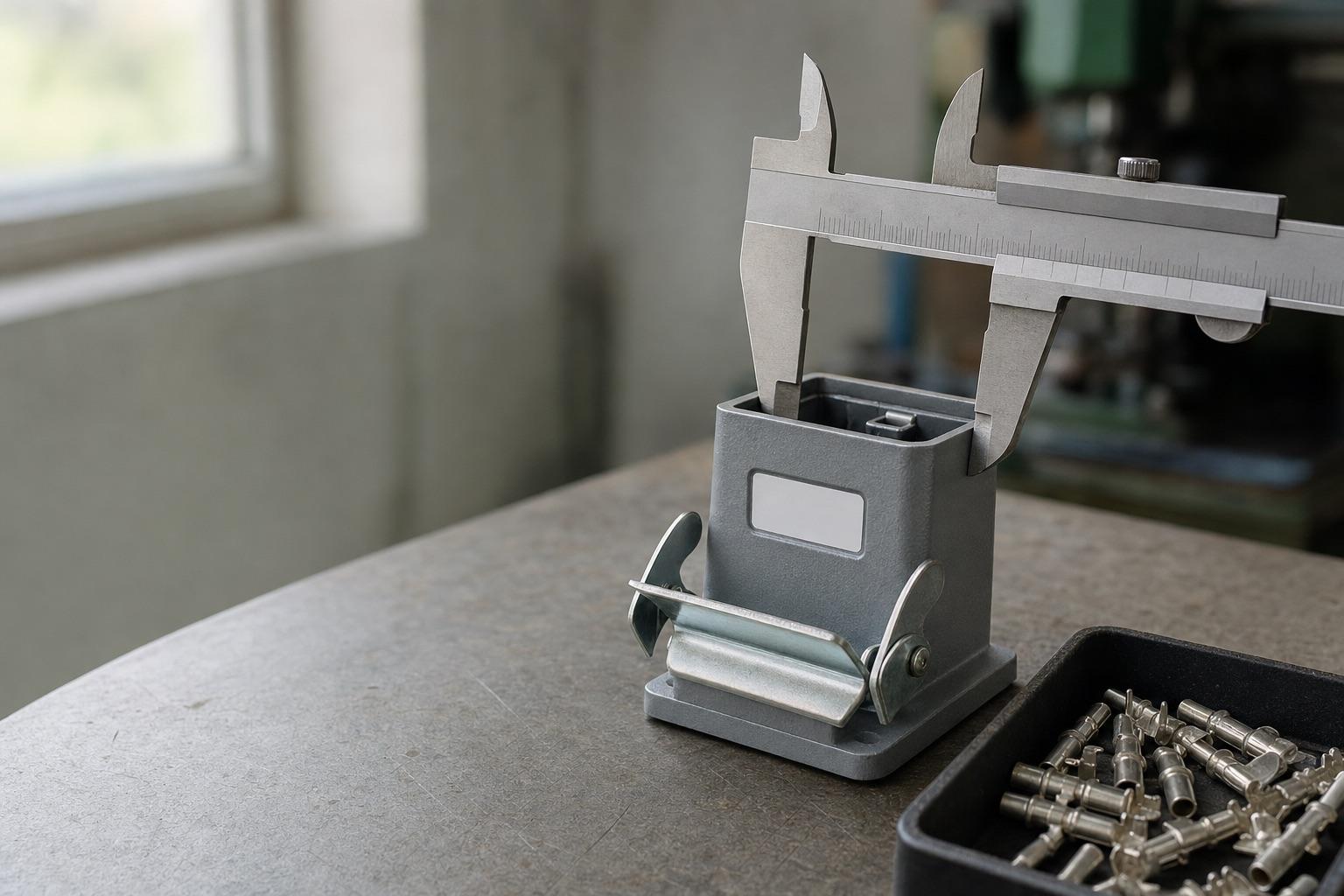
A part number is the most precise description of a connector that most engineers and buyers will ever have, and also the easiest to misread. A dropped leading zero, a missing suffix or a distributor's number mistaken for the manufacturer's can turn a simple re-order into the wrong part on the bench. This guide explains how connector part numbers are built, how to identify a part when the number is incomplete or missing, and how to judge whether an alternative is a true replacement. It assumes the connector was selected correctly in the first place; that process is covered in How to select an industrial connector.
Which number do you actually have?
One connector usually carries several identifiers, each assigned by a different party for a different purpose. Before searching, establish which one you are holding: a search that treats them as interchangeable produces near-matches rather than the part.
| Identifier | Assigned by | What it identifies | Example |
|---|---|---|---|
| Manufacturer part number (MPN), ordering code | The manufacturer | One orderable variant, including options such as plating or packaging | HARTING 09 14 032 0371; Telegärtner J01121A0134 |
| Distributor article number | The distributor | The same item in that distributor's systems only | Belko 5013073 |
| GTIN-13 (EAN) | The brand owner, under its GS1 company prefix | A trade item, for logistics and barcode scanning | 4018359263737 |
| Type designation or series name | The manufacturer | A design or family, not necessarily one orderable item | Han DD Quad module; 7-16 |
| Customer or drawing number | The equipment maker | The part's role in a bill of materials, possibly with approved alternatives | Internal; not searchable outside the company |
Only the manufacturer part number should define a part on a drawing or bill of materials. The other identifiers help to find it.
GS1 describes the GTIN as a unique, global product identifier; GTIN-13 is the 13-digit form that is usually called EAN in Europe. It is reliable for matching a delivery to an order, but it rarely appears on drawings or datasheets, so it works best as a cross-check rather than as the engineering identifier.
Significant and non-significant numbers
Manufacturers follow one of two approaches, and many use both. A significant (sometimes called intelligent) number encodes features in fixed positions: series, size, contact arrangement, gender, termination, plating. Such a number can often be built from an ordering-key table in the catalogue. A non-significant number is a sequential identifier whose digits carry no meaning; the features live only in the data behind it. Neither is better, but they call for different habits. A significant number tempts the reader to decode it by eye, which is safe only with the manufacturer's own ordering key at hand. A non-significant number cannot be decoded at all and must be looked up.
Separators, leading zeros and suffixes
- Spaces, dashes and dots are often presentation only. HARTING prints its numbers in groups, such as
09 14 032 0371, while its own web addresses and many ERP systems use09140320371. Search both forms. - Leading zeros are real characters. A spreadsheet that converts a part number into a number silently turns
09140320371into9140320371. Format part-number columns as text. - Suffixes often select plating, packaging (tube, tray, tape and reel), colour or a customer-specific variant. A number without its suffix may be a different product, or no product at all.
Identifying a part without a reliable number
When the label is gone or the number is incomplete, collect physical evidence before searching. Several observations together identify a part; one rarely does.
- Markings: manufacturer logo, series name, part number and date code on the housing, coupling nut, flange or insert. Inserts often carry contact numbers on the mating face and the termination side.
- Contact count and layout: count all positions, including empty ones, and note rows, pitch and any larger power or coaxial positions.
- Gender of the contacts and of the housing, recorded separately.
- Coding: keys, keyways, coded inserts, or the position letter of a module in a frame.
- Dimensions: thread, flange, panel cut-out and overall length, measured with callipers rather than estimated from a photograph.
- Termination: crimp barrel, solder cup, board pins, insulation displacement, or screw or spring-clamp terminals.
- Context: cable labels, the assembly drawing, the mating half and the equipment's spare-parts list.
Photograph the part from the mating face, the side and the termination end, with a ruler in the frame. Photographs and mechanical drawings are more dependable evidence than web descriptions, which are written to be found rather than to be verified.
Recognising the family
| Family | Typical visual cues | Still to be identified |
|---|---|---|
| D-Sub | Trapezoidal metal shell, two or more rows of contacts, often screw locking | Shell size, contact count, standard or high density, termination, locking hardware |
| M12 circular | M12 × 1 coupling thread, small round insert | Coding, contact count, straight or angled, cable or panel version |
| Han-Modular | Rectangular hood and housing; a hinged frame holding lettered modules | Frame size and lettering, module types and positions, contacts, gender |
| RF coaxial (BNC, TNC, SMA, N, 7-16) | Single centre contact inside an outer conductor; bayonet or threaded coupling | Series, impedance, centre-contact gender, cable group or mounting style |
Visual cues indicate a family. Only the datasheet confirms a variant.
Male, female, plug, jack and receptacle
Gender terms cause more wrong orders than any other attribute. On multipole industrial connectors, gender usually refers to the contacts (pins male, sockets female), while the housing is named separately as plug, receptacle, hood or housing, depending on the manufacturer. In RF, a TE Connectivity application note observes that male/female and pin/socket most often describe the centre conductor, plug and jack most often describe the housing, and that there are no firm conventions across the industry. Reverse-polarity SMA swaps the centre contacts, so an RP-SMA plug has a socket centre contact. Record the centre contact and the coupling (internal or external thread, bayonet) separately and compare both with the drawing. The differences between the common RF families are set out in RF connector types compared.
Worked example: one product, several numbers
The numbers below are published HARTING, Telegärtner and FCT parts listed in the Belko catalogue. They illustrate how identifiers relate to each other; they are not a design recommendation.
The frame is in the catalogue as Han hinged frame, 8 modules a-h. Note that a complete Han-Modular order is a set: frame, modules, contacts, hood and housing, each with its own number.
One product, three identifiers: a 7-16 bulkhead jack
- Description
- 7-16 bulkhead jack G10 (UT-141) IP 68
- Manufacturer
- Telegärtner
- Manufacturer part number
- J01121A0134
- Belko article number
- 5013073
- GTIN-13 (EAN)
- 4018359263737
Each number finds the same item in a different system. Only the manufacturer part number belongs on the drawing.
Fragment searches are the opposite case. A search for 0Q1A matches the Telegärtner "Owl Upgrade Clip Fiber Owl UCF 0Q1A 000", manufacturer part number F50810A0000. The string is part of a product designation, not a complete identifier, and its characters should not be decoded by guesswork; the match is certain only once designation, manufacturer number and application agree. Similarly, Belko article 5011649 is an FCT (a Molex company) D-Sub 25-pin male crimp connector, type FQ25P7-4744: the article number found it, but the manufacturer's designation is what goes on the drawing.
Termination and compatibility checks
A part that mates correctly can still be the wrong part if it cannot be terminated with the existing cable, tools or board. When replacing a connector, check the termination first.
| Termination | What must match |
|---|---|
| Crimp | Contact part number, conductor cross-section and insulation diameter range, crimp tool and die; contacts are often ordered separately |
| Solder cup | Conductor size, cup size, heat resistance of the insert during soldering |
| PCB through-hole (THT) | Footprint, pin length against board thickness, soldering process |
| PCB surface mount (SMT) | Land pattern, reflow profile, packaging suited to the placement machine |
| Insulation displacement (IDC) | Cable type and pitch, solid or stranded conductor as specified |
| Screw or spring-clamp terminal | Conductor range, use of ferrules, tightening torque or clamp type |
- Mechanical: mating interface, coupling, panel cut-out, mounting, and space for the cable bend and the hand.
- Electrical: current per contact, rated voltage, creepage and clearance, shield continuity, and impedance for RF and data lines.
- Environmental: IP rating in the mated state, temperature range, exposure to oils, cleaning agents and UV, vibration.
- Materials and compliance: contact plating compatible with the existing mating half, RoHS and REACH declarations, flammability rating where the equipment requires one.
Assessing alternatives and cross-references
Cross-reference tables from manufacturers and distributors are a useful start, but they compare catalogue attributes, not applications. It helps to distinguish three levels of match.
Levels of equivalence
Intermateable
Mates with the existing counterpart
- Same interface dimensions, often defined in an IEC 61076 or IEC 61169 interface standard
- Ratings, materials, plating and sealing may still differ
- Both datasheets need checking before makes are mixed
Form-fit-function (FFF)
A drop-in replacement
- Same interface, mounting, termination and footprint
- Ratings equal to or better than the application requires
- No change to tools, drawings or assembly process
Functional alternative
Does the job after a design change
- Different interface, footprint or termination
- Needs a drawing change and often requalification
- Can be the better long-term answer for an obsolete part
Obsolete and end-of-life parts
Connector series have long lives, but they are revised and variants are discontinued. Manufacturers announce changes in a product change notification (PCN) and discontinuations in an end-of-life (EOL) or discontinuance notice, usually with a last-time-buy date. In the electronics supply chain, documents such as J-STD-046 (product and process change notification) and J-STD-048 (product discontinuance) describe how such notices are issued; practice among connector manufacturers varies, so the notice itself governs.
- 01Confirm the status with the manufacturer or distributor, and whether a successor number exists.
- 02Check whether the successor is form-fit-function or only intermateable.
- 03Estimate remaining demand, including spares and service, before the last-time-buy date.
- 04Choose between a last-time buy, a qualified alternative and a redesign, and record the decision.
IEC 62402:2019, Obsolescence management, gives requirements and guidance for doing this systematically: an obsolescence management policy and plan, design strategies that reduce exposure, and the selection of resolutions. For equipment with a long service life, planning this at the design stage costs less than reacting to an EOL notice. Questions about availability and alternatives are handled through Belko's component sourcing.
Requesting technical advice
A complete information package turns an identification request from guesswork into a check. Send as much of the following as is available:
- 01The number exactly as found, with a photograph of the marking.
- 02Manufacturer and series, if known.
- 03Photographs of the mating face, side and termination, with a scale in the picture.
- 04Gender of contacts and housing, contact count and any coding.
- 05The mating half: its number, or photographs.
- 06Cable type and conductor cross-section, or board thickness and footprint.
- 07Operating conditions: current, voltage, temperature range and IP requirement.
- 08Quantity, required date, and whether only a drop-in replacement is acceptable.
- 09Approvals or certifications that apply to the equipment.
With this information, a Belko specialist can check the part against the manufacturer's data and say whether an alternative is a true replacement.
Key takeaways
- 01The manufacturer part number defines the part; distributor numbers and GTIN-13 help to find it.
- 02Field meanings in a part number are valid only for the catalogue they come from; never decode by analogy.
- 03Store part numbers as text: separators may be cosmetic, leading zeros, suffixes and letter case are not.
- 04Identify an unknown part from several observations: markings, contacts, gender, coding, dimensions and termination.
- 05Intermateable is not equivalent. Check form, fit and function, and plan for obsolescence before the EOL notice arrives.
Frequently asked questions
Is 09 14 032 0371 the same part number as 09140320371?
Yes. HARTING prints its numbers in groups for legibility and uses the unspaced form in its own web addresses, and both refer to the same "Han hinged frame plus, for 8 modules a-h". Spaces are presentation; characters are not. Dropping the leading zero or any digit produces a different, often non-existent number, so search both forms and compare the product name with the manufacturer's listing.
I only have part of a number, such as 0Q1A. Can the part still be identified?
Usually, if the fragment is combined with other evidence. A fragment search returns candidates; in the Belko catalogue, 0Q1A appears in the designation of a Telegärtner fibre upgrade clip with manufacturer number F50810A0000. Confirm a candidate with the full designation, photographs, the application and, where possible, the mating part before ordering.
Is an intermateable connector from another manufacturer a drop-in replacement?
Not automatically. Intermateable means the interfaces mate; a drop-in replacement also has to match mounting, termination, ratings, plating, sealing and any approvals the equipment relies on. Compare both datasheets line by line, and treat mixed-make mated pairs in sealed or safety-relevant connections with particular care.
Why are contacts not included with a Han-Modular crimp module?
HARTING states for its crimp modules that the crimp contacts are ordered separately. The module provides the insulating body and contact positions, while the contacts are chosen to suit the conductor cross-section and carry their own part numbers. A bill of materials for a crimp module is complete only when the contact numbers are on it.
References
- [1]Han hinged frame plus, for 8 modules a-h — 09 14 032 0371 — HARTINGProduct name, size L32 B, PE conductor cross-sections; grouped and unspaced number forms.
- [2]Han-Modular hinged frames (product listing) — HARTINGFrames listed in pairs with upper-case and lower-case module lettering under different numbers (e.g. 09 14 032 0361 A-H).
- [3]Han Full High Density Module, crimp-M — 09 14 036 3001 — HARTING36 contacts, single module, crimp; crimp contacts ordered separately.
- [4]Han Full High Density Module, crimp-F — 09 14 036 3101 — HARTINGFemale counterpart of 09 14 036 3001.
- [5]Han DD Quad module male — 09 14 042 3001 — HARTING42 contacts, double module, crimp; crimp contacts ordered separately.
- [6]RF Coaxial Connector Gender Naming (Application Note AN21067-03CON) — TE Connectivity / Linx TechnologiesCentre conductor vs housing terminology, RP-SMA, no firm industry conventions.
- [7]IEC 62402:2019 Obsolescence management — International Electrotechnical CommissionScope: obsolescence management policy, plan, design strategies and resolutions.
- [8]What is the difference between a GS1 GTIN, a barcode, an EAN and a UPC? — GS1GTIN-13 is also called EAN.
Related knowledge
Solution directions
Applications
In the catalogue
- 504480709 14 032 0371 Han Hinged Frame, 8 Modules A-H
- 5044808Han Full High Density Module 09 14 036 3001
- 504480909 14 036 3101 Han Full High Density Module, crimp-F
- 504481009 14 042 3001 Han DD Quad Module Male
- 504481109 14 042 3101 Han DD Quad Female Module
 J01121A0134Telegaertner J01121A0134 7-16 Bulkhead Jack G10 (UT-141) IP 68
Apply it to your design
Need help applying this?
Send your requirements, drawing or part number. A Belko specialist reviews it with this article as context.