
RoHS exemption 6(c): what engineers and buyers need to know
Exemption 6(c) of RoHS Annex III allows copper alloy containing up to 4 % lead by weight, and it sits behind most machined brass and bronze contacts in connectors. This article covers the exact wording after Delegated Directive (EU) 2025/2364, the legal status as of November 2026, the separate REACH duties for lead, what a supplier declaration should state and what changes when a contact moves to a lead-free alloy.
- Reading time
- 13 min read
- Document
- Rev. 1
- Level
- Intermediate
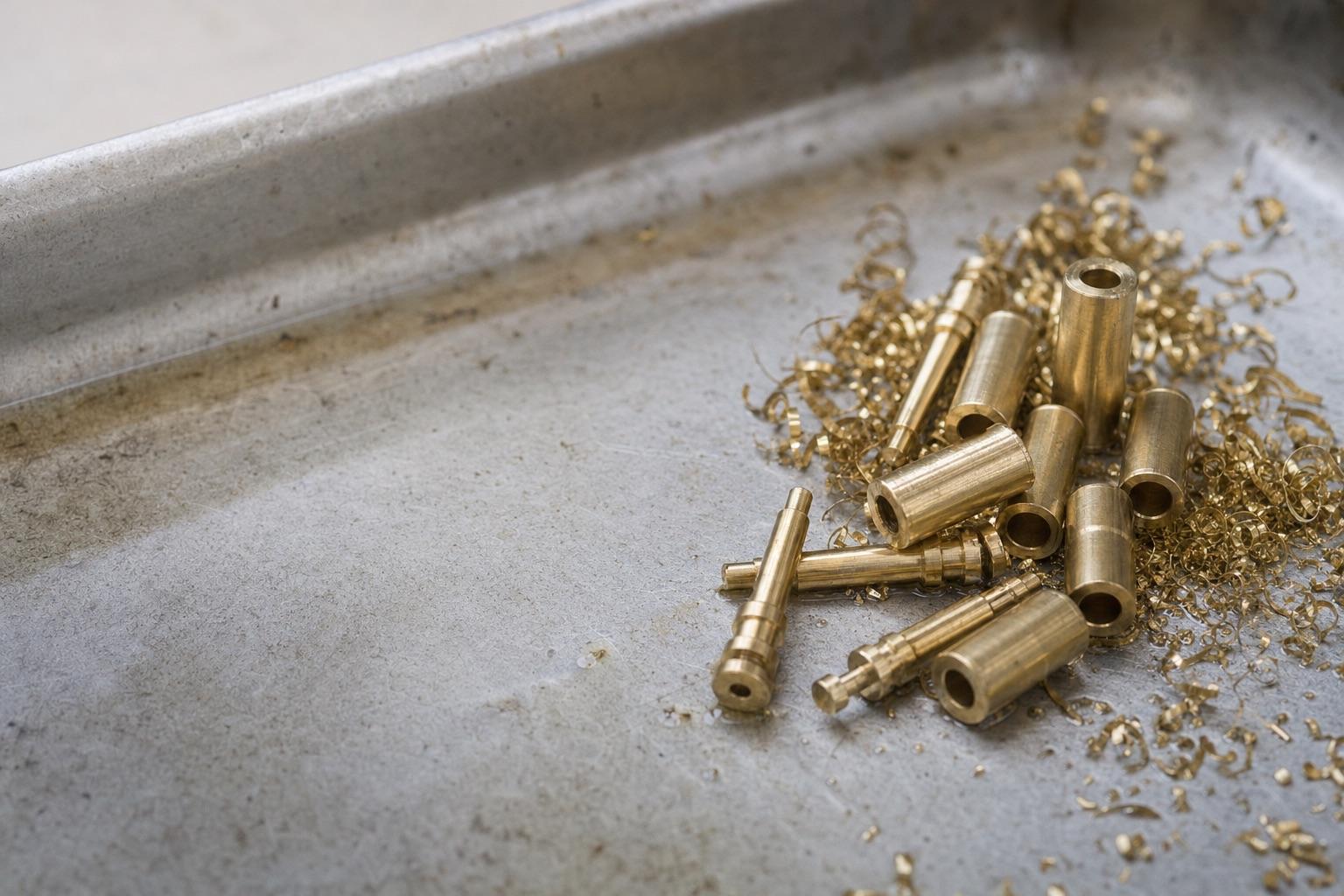
Exemption 6(c) is a single line in Annex III of the RoHS Directive, yet it sits behind a large share of the turned contacts, pins and sockets in industrial and RF connectors. It allows copper alloy containing up to 4 % lead by weight in electrical and electronic equipment, where lead is otherwise limited to 0.1 % by weight in each homogeneous material. For engineers it explains why so many machined contacts are made from leaded brass; for buyers it is the exemption most often printed on a connector's RoHS declaration.
This article looks at 6(c) in detail: its exact wording, why the industry relies on it, where its legal status stands as of November 2026, how it interacts with REACH and what a lead-free alternative changes in practice. The general framework — the ten restricted substances, homogeneous materials, how exemptions are granted and expire, and the SCIP database — is covered in RoHS and REACH explained and is not repeated here. The article describes the legal position in general terms and is not legal advice; compliance decisions remain with the company that places the product on the market.
What exemption 6(c) says
Since Commission Delegated Directive (EU) 2025/2364 the entry reads, word for word: Copper alloy containing up to 4 % lead by weight, followed by a footnote marker. Three points matter when you read it.
- It is a material limit, not an application list. 6(c) does not name connectors, contacts or any product type. Any copper alloy — brass, bronze, nickel silver, copper beryllium — is covered as long as its lead content does not exceed 4 % by weight.
- The 4 % applies to the alloy as a homogeneous material. A contact body in CuZn39Pb3, with around 3.3 % lead, is covered. The plating, a solder joint or the insulator on the same part are assessed separately and cannot borrow the exemption.
- One expiry date for all categories. Earlier versions set different dates for different categories of equipment; the 2025 wording gives a single date for all of them.
The footnote is new in the 2025 version and applies to entries 6(a)-I to 6(c). It excludes EEE supplied to the general public where the equipment or an accessible part of it — smaller than 5 cm in one dimension, or with a detachable or protruding part of that size — may be placed in the mouth by children, unless lead release is shown not to exceed 0.05 µg/cm² per hour. The Commission added it to align RoHS with the lead restriction in entry 63 of REACH Annex XVII. For connectors built into professional equipment the effect is marginal; for small consumer devices it deserves a check.
| Entry | Scope | Expiry stated in Annex III |
|---|---|---|
| 6(a), 6(a)-I, 6(a)-II | Lead in steel: for machining purposes up to 0.35 %, in batch hot-dip galvanised components up to 0.2 % | 6(a): 12 months after entry into force of the delegated directive; 6(a)-I and 6(a)-II: 30 June 2027, all categories |
| 6(b), 6(b)-I, 6(b)-II, 6(b)-III | Lead in aluminium: up to 0.4 %, or up to 0.3 % in casting alloys from recycled scrap | 12 or 18 months after entry into force, or 30 June 2027, depending on the entry and the equipment category |
| 6(c) | Copper alloy containing up to 4 % lead by weight | 30 June 2027, all categories |
All percentages are by weight. Entries 6(a)-I to 6(c) carry the footnote on parts that children may place in the mouth. The legal reference is the consolidated Annex III on EUR-Lex.
Why connector contacts use leaded brass and bronze
In a leaded copper alloy the lead is not dissolved in the matrix but embedded in it as tiny, soft nodules. The assessment report from the last review of 6(c) (Pack 22, 2022) summarises the effect: lead acts as an internal lubricant and chip breaker during machining and helps prevent cracking of the material. At the cutting edge the lead particles make the chip break short instead of forming long coils, and they reduce friction, so cutting forces and tool wear fall. That is what allows small bores, threads, slots and knurls to be produced at high speed on automatic lathes with a consistent surface finish.
The standard free-cutting alloy is CuZn39Pb3 (CW614N). Its machinability is the 100 % reference against which other copper alloys are rated, and Wieland's datasheet gives a reference lead content of 3.3 %, an electrical conductivity of 14.6 MS/m (25 % IACS) and rates its suitability for electroplating as excellent. Leaded bronzes, leaded nickel silver and leaded copper beryllium are used in smaller quantities for parts that need higher strength, spring properties or corrosion resistance.
The applicants in the last review, among them an industry project represented by Rosenberger and Phoenix Contact, named connections for data, signal and power as the main use in EEE. In connectors, that means turned pin and socket contacts, RF centre and outer conductors, coupling nuts and machined bodies. Examples of this type of part are the gold-plated male contact for N connectors and the Han C male crimp contact for 4 mm². Parts like these are where 6(c) typically appears on a declaration, but whether a specific part relies on it can only be read from the manufacturer's declaration for that part number.
Legal status as of November 2026
The wording of 6(c) has not changed since the first RoHS Directive, 2002/95/EC. What has changed is its validity period and the procedure around it.
| Date | Event |
|---|---|
| 1 March 2018 | Delegated Directive (EU) 2018/741 renews 6(c), with expiry dates between 21 July 2021 and 21 July 2024 depending on the category. |
| 15 and 16 January 2020 | Two renewal applications received within the deadline. 6(c) remains valid while they are assessed. |
| October 2020 – February 2022 | Commission assessment study (Pack 22), including a public consultation from 23 December 2020 to 3 March 2021. |
| 8 September 2025 | Commission adopts Delegated Directive (EU) 2025/2364 on lead as an alloying element in steel, aluminium and copper. |
| 21 November 2025 | Publication in the Official Journal; entry into force on 11 December 2025. |
| 10 December 2025 | New renewal request for 6(c) recorded by the Commission (last date for submission: 30 December 2025). |
| 1 July 2026 | Member States apply the new Annex III wording (transposition deadline 30 June 2026). |
| 30 June 2027 | Expiry date stated in Annex III for 6(c), all categories. |
Sources: Commission document C(2025) 5961 and its annex as transmitted to the Council; the Commission's exemptions overview, version of 28 February 2026, which lists 6(c) as "valid – requested for renewal" and is a documentation tool without legal effect.
Under Article 5(5) of the RoHS Directive, an exemption for which renewal was requested in time remains valid until the Commission has decided on the request. On the evidence available, 6(c) is valid as of November 2026 and will stay valid after 30 June 2027 until a decision on the request recorded in December 2025. If renewal were refused, the exemption would expire no earlier than 12 and no later than 18 months after that decision. As of 26 November 2026 we found no published assessment study or Commission decision on that request. Before relying on any date, check the current consolidated Annex III on EUR-Lex and the Commission's RoHS exemption pages.
The RoHS exemption does not cover REACH
Lead (EC 231-100-4) was added to the REACH Candidate List on 27 June 2018 as toxic for reproduction under Article 57(c). A RoHS exemption has no effect on REACH. A machined contact in CuZn39Pb3 contains more than 30 times the 0.1 % threshold, so every supplier of that contact in the EU has the Article 33 duty to name lead to its customers, and suppliers that place it on the EU market must notify it to ECHA's SCIP database.
- The threshold applies to the article. The contact is the article, not the connector or the finished device, so the lead content cannot be diluted by the weight of a larger product. Gold or silver plating on the contact does not change this.
- The information travels up the chain. When the contact is built into a connector, a cable assembly or a device, it remains an article in its own right. Each assembly level has to pass on the Candidate List information, and SCIP notifications at each level can refer to the notification made upstream.
- REACH Annex XVII entry 63 is a separate restriction. It limits lead in accessible parts of consumer articles that children could put in their mouths but excludes EEE within RoHS scope; the new 6(c) footnote closes that gap from the RoHS side.
Consequences for OEMs and buyers
In the technical documentation
The equipment manufacturer has to demonstrate compliance for every homogeneous material, usually following EN IEC 63000. Where a component relies on 6(c), record per part the exemption number, the declaration it comes from and its date, and the expiry status of the exemption. Many manufacturers also state the exemptions they use in the EU declaration of conformity or in its supporting documents. Either way, an auditor should be able to trace the path from the finished product to the declaration of each contact, and your review interval should follow the 6(c) procedure as well as the twice-yearly Candidate List updates.
What a good supplier declaration contains
- The exact manufacturer part numbers covered, including plating and material variants.
- A RoHS statement covering Directive 2011/65/EU with Annex II as amended by Delegated Directive (EU) 2015/863.
- The exemption numbers relied on, cited against the current Annex III — 6(c) as worded since Delegated Directive (EU) 2025/2364 — preferably with the homogeneous material concerned (for example, contact base metal).
- A REACH statement naming lead where it exceeds 0.1 % by weight of the article, with the date or edition of the Candidate List checked.
- The SCIP notification number, or a reference to it, where an SVHC is declared.
- Date of issue, issuing company and signatory, and a commitment to notify material changes.
Buyer checklist
| Check | What to look for | Why it matters |
|---|---|---|
| Exemption named | "6(c)" stated explicitly, not only "RoHS compliant with exemptions" | You need to track the expiry and any future split of the entry |
| Wording version | Reference to the current Annex III, after Delegated Directive (EU) 2025/2364 | Older declarations may cite the category-specific dates of 2018/741 |
| Material | Alloy designation (e.g. CuZn39Pb3) or the lead range of the base metal | Confirms the 4 % limit and the REACH position |
| REACH | Lead named, with the Candidate List date checked | This is the Article 33 information you must pass on |
| SCIP | Notification number or reference | Lets you refer to it in your own notification |
| Consumer use | Statement on the footnote if the product reaches the general public | The exemption may not cover small parts that children could mouth |
| Change notice | Commitment to notify a change of alloy | A switch to lead-free alloy affects form, fit and function |
A declaration is evidence for your technical documentation, not a certificate. Where it is vague, ask the manufacturer for the full material declaration.
Collecting manufacturer declarations for a bill of materials is part of component sourcing; for a specific part number you can ask a Belko specialist.
Lead-free alternatives and what they change
The Pack 22 assessment concluded that there is no single substitute for all applications: lead-free copper alloys exist, but they are not drop-in replacements and need adaptations in alloy composition, machining or both. The main candidates are compared below; values are reference values from the cited datasheets and reports, and the datasheet of the specific semi-finished product governs.
Leaded brass and its lead-free alternatives
CuZn39Pb3 (CW614N)
Leaded free-cutting brass, relies on 6(c)
- Reference lead content 3.3 % (Wieland)
- Machinability index 100 % — the reference
- Conductivity 14.6 MS/m (25 % IACS)
- Electroplating rated excellent; poor cold workability
CuZn21Si3P (CW724R)
Silicon brass, e.g. Ecobrass or Wieland eco SW1
- Lead max. 0.09 % (Wieland eco SW1)
- Machinability 90 % per Wieland; 70–75 % per the industry applicants in Pack 22 — sources differ
- Conductivity 4.5 MS/m (7.8 % IACS), about a third of CW614N
- Higher strength; small-bore drilling reported as difficult
CuZn40 / CuZn42
High-zinc brass without a chip-breaking phase
- Lead ≤ 0.1 % grades
- Long chips, higher tool wear, chatter marks and burrs reported
- Lower cold formability; cracks reported in crimp barrels
- Seen in Pack 22 as most promising for simple power contacts without bores or knurls
Bismuth brasses
Bismuth as chip breaker instead of lead
- Machinability effect comparable to lead
- Deutsches Kupferinstitut advises against their use
- A few ppm of bismuth in the scrap stream can disrupt hot working of other copper alloys
- Risk of stress corrosion cracking cited
Engineering caveats before you switch
- Machining: feeds, speeds, tooling and chip control change; small bores, knurls and fine threads are the usual bottlenecks, with consequences for cycle time and tool cost.
- Conductivity and temperature rise: a base metal with a third of the conductivity raises the resistance of power contacts and changes the current rating. For RF parts, the plating carries most of the current at high frequencies, but DC resistance and the plating stack still need to be verified.
- Plating: a different alloy surface may need a different pre-treatment; adhesion and porosity of nickel and gold layers have to be validated again.
- Contact behaviour: stress relaxation determines whether a socket keeps its normal force over life, and crimp barrels must form without cracking. Both feed directly into contact resistance and reliability.
- Requalification: a change of base alloy is a change to form, fit and function. Expect re-testing against the relevant IEC 60512 tests or the customer specification, updated declarations and, where they apply, renewed approvals.
Key takeaways
- 016(c) exempts copper alloy containing up to 4 % lead by weight, assessed per homogeneous material; it covers turned brass and bronze contacts but never plating or solder.
- 02Since Delegated Directive (EU) 2025/2364, applied from 1 July 2026, 6(c) carries one expiry date of 30 June 2027 for all categories plus a footnote on parts children may mouth.
- 03A renewal request recorded in December 2025 keeps 6(c) valid beyond 30 June 2027 until the Commission decides; a narrower scope at that decision is plausible.
- 04Lead has been on the REACH Candidate List since June 2018: a leaded contact triggers Article 33 communication and SCIP notification regardless of RoHS.
- 05Lead-free brasses are not drop-in replacements: conductivity, machining, plating, stress relaxation and crimping all need requalification.
Frequently asked questions
Is a connector that uses exemption 6(c) RoHS compliant?
Yes. A part that exceeds an Annex II limit only in an application listed in Annex III is compliant for as long as that exemption is valid for the equipment category concerned. The declaration should then say "compliant with exemptions" and name them, because the compliance is conditional on the exemption remaining in force.
What happens to 6(c) after 30 June 2027?
The Commission's exemption overview records a renewal request for 6(c) dated 10 December 2025, within the 18-month deadline. Under Article 5(5) the exemption remains valid until the Commission decides on that request. A decision may renew it unchanged, renew it with a narrower scope or new sub-entries, or refuse it, in which case it expires 12 to 18 months after the decision. As of November 2026 no decision had been published.
Our contacts are gold-plated. Do we still have to declare lead under REACH?
Yes, if the contact as a whole contains more than 0.1 % lead by weight. Under REACH the calculation is made per article, and the plating is part of that article; it does not reduce the lead content of the base metal. The Article 33 duty and, for EU suppliers, the SCIP notification apply independently of whether the part is RoHS compliant through 6(c).
Can we switch a contact to lead-free brass without requalification?
Not safely. Silicon brass has about a third of the conductivity of CuZn39Pb3, high-zinc brasses crimp and relax differently, and both machine and plate differently. Treat an alloy change like any other change to form, fit and function: test contact resistance, temperature rise, retention force, crimp quality and durability on the new parts, and update the declarations.
References
- [1]Commission Delegated Directive (EU) 2025/2364 of 8 September 2025 amending Directive 2011/65/EU as regards an exemption for lead as an alloying element in steel, aluminium and copper — European Union — Official Journal / EUR-LexCurrent wording of 6(a)–6(c), footnote and expiry 30 June 2027. Check the consolidated Annex III to Directive 2011/65/EU on EUR-Lex for the legally binding text.
- [2]Commission Delegated Directive C(2025) 5961 final with explanatory memorandum, as transmitted to the Council (ST 12658/25) — Council of the European UnionHistory of 6(c), renewal applications of January 2020, technical conclusions and the Article 5(5) rule.
- [3]Annex to Commission Delegated Directive C(2025) 5961 final (ST 12658/25 ADD 1) — Council of the European UnionReplacement text of Annex III points 6(a) to 6(c) and the footnote.
- [4]Exemptions list: validity and rolling plan (version 28 February 2026) — European Commission, DG Environment6(c): renewal request dated 10 December 2025, status "valid – requested for renewal". Documentation tool without legal effect.
- [5]Study to assess requests for a renewal of nine exemptions 6(a), 6(a)-I, 6(b), 6(b)-I, 6(b)-II, 6(c), 7(a), 7(c)-I and 7(c)-II of Annex III of Directive 2011/65/EU (Pack 22), final report — European Commission / Publications Office of the EU (Oeko-Institut and partners)Function of lead in copper alloys, applicants, lead-free alternatives and their limitations.
- [6]Candidate List of substances of very high concern for Authorisation — lead (EC 231-100-4) — European Chemicals Agency (ECHA)Included on 27 June 2018 as toxic for reproduction (Article 57(c)).
- [7]Wieland-Z32/Z33 CuZn39Pb3 (CW614N) and eco SW1 CuZn21Si3P (CW724R) material datasheets — Wieland-Werke AGComposition, conductivity, machinability index and fabrication ratings. The Z32/Z33 datasheet is at https://www.wieland.com/da/content/download/9842/file/Z32-Z33_EX_EN.pdf.
- [8]The effects of using bismuth as lead replacement (factsheet) — Deutsches KupferinstitutReasons the copper industry advises against bismuth as a lead substitute.
Related knowledge
Solution directions
Applications
In the catalogue
Apply it to your design
Need help applying this?
Send your requirements, drawing or part number. A Belko specialist reviews it with this article as context.