
Engineering Knowledge Center
Engineering knowledge. Practical answers.
Technical insights, selection guides and application knowledge for reliable connectivity.
9 results for “RF connector types”
- 01
Technical Guides12 min read
BNC, TNC, SMA, N-Type and 7/16 Connectors: Which RF Connector Do You Need?A practical comparison of the BNC, TNC, SMA, N, 7-16 and 4.3-10 coaxial connector families: impedance variants, typical frequency limits, coupling threads and torques, power class, sealing and cable groups. With a selection sequence, a selection matrix and the mating mistakes that most often degrade RF links. - 02
Technical Guides12 min read
How to identify and select the right industrial connector by part numberA connector part number is precise only when it is read correctly. This guide explains manufacturer, distributor and GTIN-13 numbers, how to identify a part whose label is missing, and how to judge alternatives and obsolete parts against form, fit and function. - 03
Product Knowledge13 min read
1.6/5.6 coaxial connectors: applications, specifications and selection guideThe 1.6/5.6 connector is a 75 Ω coaxial interface defined in IEC 60169-13 and widely used in telecom transmission equipment. This guide explains the name and the standards behind it, the frequency and return-loss data manufacturers publish, the coupling variants and cable groups, and how 1.6/5.6 compares with BNC, 1.0/2.3 and HD-BNC. - 04
Technical Guides10 min read
How to select an industrial connectorA structured way to choose an industrial connector: define the electrical load, the mechanical and environmental conditions at the connector, the termination and the mating regime, then let each requirement rule out connector families. Ratings are only meaningful together with the conditions under which the datasheet states them. - 05
Technical Guides11 min read
Connector selection for high-vibration environmentsVibration rarely breaks a connector outright; it degrades the contact interface through micromotion, fretting and intermittent interruptions. This guide explains the failure mechanisms, the connector and cable features that resist them, and how sinusoidal, random and shock tests are used to qualify a connection. - 06
Standards & Compliance10 min read
Understanding IP ratings for connectorsThe IP code of IEC 60529 states how well an enclosure keeps out solid objects and water under defined test conditions. For connectors, the code is only meaningful together with the state in which it was tested — mated, unmated or capped — and it says nothing about temperature, chemicals or seal ageing. ISO 20653 adds K-suffixed codes such as IPX9K for road vehicles. - 07
Engineering Insights9 min read
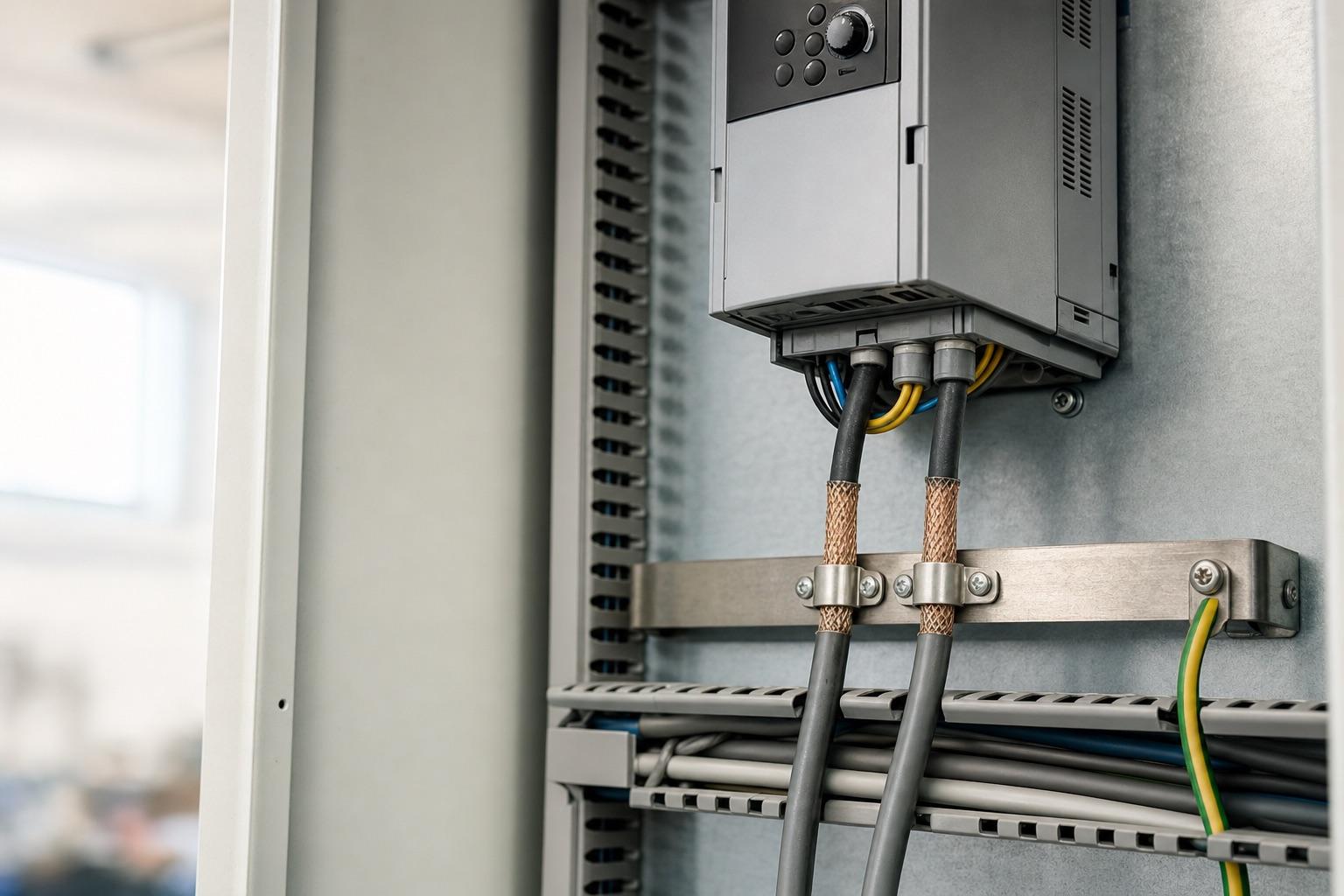
Shielded vs unshielded connectorsA shield only improves electromagnetic compatibility when it is continuous from cable to housing to panel, with low impedance at the frequencies that matter. This article explains how foil and braid shields work, what transfer impedance measures, why 360° termination outperforms pigtails, how to approach shield grounding, and when an unshielded connection is the better engineering choice. - 08
Engineering Insights14 min read
EMC troubleshooting: finding and eliminating interference in industrial connectionsA practical method for tracing electromagnetic interference in machines and control cabinets: recognising the symptoms, identifying the source and the coupling path, measuring with simple field tools and fixing the installation — routing, bonding and shield termination at connectors, glands and housings. - 09
Technical Guides9 min read
Cable assembly design considerationsA cable assembly is a small system: conductors, insulation, jacket, shielding, terminations, connectors and strain relief that must work together for the life of the equipment. This guide covers requirements capture, material and termination choices, testing and the documentation that makes an assembly reproducible.

Engineering support
A question no article answers?
Send us your application, drawing or part number. A Belko specialist helps you determine the right connection.